

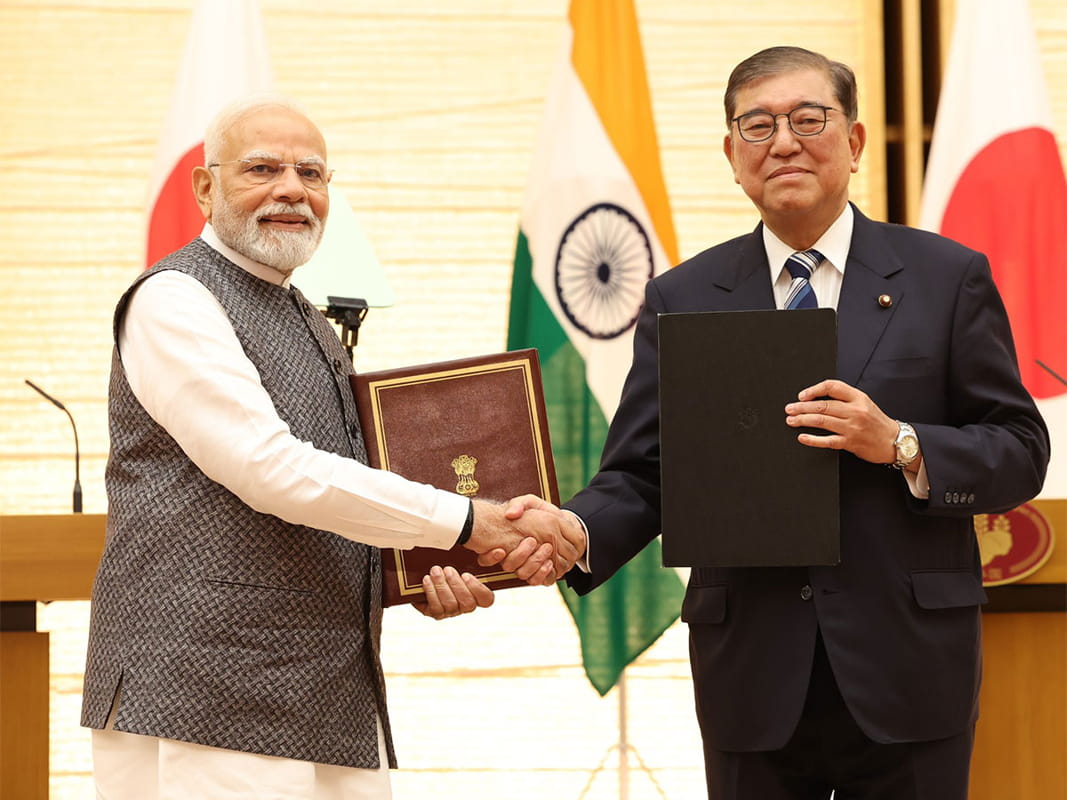
Indian Prime Minister Narendra Modi meets Prime Minister of Japan, Shigeru Ishiba in Japan on August 30, 2025. | @PMOIndia/X.

To expand its strategic autonomy, India must instrumentalize market access to create mutual global dependencies by diversifying its export destinations beyond the US and its supply lines beyond China.
This requires a highly calibrated strategy: selectively trading domestic market access for Chinese manufacturing investments while simultaneously deepening trade and defense interlinkages with the EU and ASEAN as they seek alternatives to the US-China binary. Underpinning this industrial expansion, India must secure resilient global commodity pipelines and leverage its crude oil refining dominance to resist external pressure on energy transitions, while remaining willing to grant targeted trade concessions to Washington in order to lock in indispensable partnerships in advanced technologies like AI and semiconductors.
Introduction
The human condition craves simplicity. This is true for everyday life, and it is equally true for complex phenomena such as a nation’s foreign policy. Even seasoned scholars seek to reduce it to a pithy catchphrase or short line. Often these monikers acquire a mythology of their own. Interpreting them becomes a cottage industry, engrossing strategic affairs practitioners and scholars across the globe.
Sometimes the correlation between the phrase and the desired action or policy is clear enough. For example, at a particular stage in its history, Britain practised “Splendid Isolation”. This required it to work towards its domestic and distant imperial goals, while steering clear of all-consuming European politics. In the contemporary world, “America First” or “Make America Great Again” could be read as a cold-blooded attempt to safeguard the United States’ military, economic and technological hierarchy, whatever the cost to the international system.
In China’s case, the desire is to shape a world order that is determined by its composite national power and technological chokeholds. In parallel, it is to achieve hegemonic status in specific geographies – China’s maritime neighbourhood in the Indo-Pacific and its western hinterland in Eurasia.
For Russia, and indeed for Turkey as well, the goal is to regain political or conceptual territory and re-establish a sphere of influence that has been challenged by other, newer powers. This calls for a mix of revanchism and irredentism, and the use of both military depth and industrial instrumentalities. For better or worse, it also leads to Moscow’s and Ankara’s thinking being likened to strands of imperial grand strategy that those capitals have inherited.
Neutrality, Non-alignment, Strategic Autonomy & Multi-alignment
Where does India come in? Like the US, China and Russia, it is a continental power, with scale, internal reserves and intricate relationships with a variety of neighbours. While it has its strengths, it also has disadvantages. Arguably, India has a more challenging neighbourhood than the others. Its economic and developmental gaps, especially given the size of its population, are sharper. The expression most used currently to describe India’s foreign policy doctrine is “strategic autonomy”. Other names have also been used: “non-alignment” (in the past); “multi-alignment” (as if to describe an upgraded non-alignment, with a diversification of partnerships); and “neutrality” (largely for specific events).
What do these mean in the real world? The four terms are obviously different. If they were the same and meant precisely the same thing, there would be no need to agonise over them or persevere to understand individual manifestations. No doubt there is a common source code – the political imperative to win India space to optimise diplomatic relationships for its economic and developmental progress. That calibrated and orthodox set of assumptions has shaped the conduct of Indian foreign policy since independence.
For all the partisanship, the principles and fundamentals that influence South Block have maintained a remarkable continuity from the Nehru era to the Modi age. Indeed, the landscape the two men would have contemplated as they looked at – or look at – India’s world in their respective epochs has more in common than many would have us believe.
Yet, “neutrality” and “non-alignment” on the one hand and “strategic autonomy” and “multi-alignment” on the other certainly differ in nuance. Non-alignment was crafted in an age when India was wary of being dragged into further global conflicts. Its backdrop was two European wars in a generation that ballooned into World Wars. An additional context was the beginning of the Cold War and an emerging era of proxy hostilities promoted by the US and the Soviet Union.
No doubt the limitations of passive non-alignment, without building capabilities and all-weather security relationships, was exposed in 1962. It was a reality check and called for retooling ways and means, while recognising the validity of values and ends. Indeed, such careful, deliberate engagement with the external environment at an early juncture in a nation’s history was not unique to India.
George Washington’s farewell address to the American people in September 1796 was a treatise in non-alignment and strategic autonomy. It warned against “interweaving our destiny with that of any part of Europe, entangl[ing] our peace and prosperity in the toils of European ambition, rival-ship, interest, humour, or caprice”. It eschewed “permanent alliances with any portion of the foreign world”. In the early years of the Soviet Union, the ideological argument between “Permanent Revolution” and “Socialism in One Country” could be seen through a similar prism.
Was non-alignment and its episodic neutralism a product of realism or of defensiveness? It was a bit of both. It was also a recognition of India’s limited stakes in far-off geographies and distant contests. From the 1990s, as a reflection of the end of the Cold War and especially given India’s new economic trajectory, an evolution was required. Strategic autonomy and multi-alignment were a corollary.
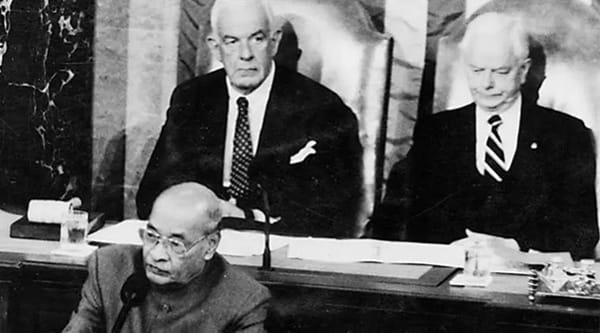
Indian Prime Minister, P V Narasimha Rao addressing the joint sitting of the US Congress on May 18, 1994. | Indian Express.
There were several triggers for this. P V Narasimha Rao’s Look East policy opened a long-delayed pathway to Southeast and East Asia. This was taken to its logical iteration by Narendra Modi’s ambitious and well-formed Indo-Pacific strategy. The decade from 1998 (Pokhran II) to 2008 (the Indo-US 123 Nuclear Agreement) saw a transformation in New Delhi’s approach to Washington, DC. From a jammer, the nuclear issue became a force multiplier.
Notwithstanding these milestones, the principal driver was the Indian economy. In 1991, when liberalisation was inaugurated in India, its GDP was about US $275 billion, with 15 per cent (about US $40 billion) coming from external trade. Today, India’s GDP is at about US $4 trillion and external trade makes up 45 per cent. Over the past 33 years, this number has grown some 15 times but external trade has risen some 45 times. Inevitably diplomacy has had to reorganise itself. After all, a country is only as neutral and non-aligned as its trading architecture allows it to be.
Take a hypothetical example. In the 1950s or 1960s, New Delhi could sit out a civil war or conflict in a South American country, one of several that dotted the Cold War. India had very limited stakes. Today, a similar infraction could have an impact on India’s energy imports, commodities and critical minerals supply chains, IT services footprint, and industrial exports.
Whereas a non-alignment or neutrality paradigm could have turned its back on the situation, a multi-alignment or strategic autonomy template would activate and deploy diversified relationships to safeguard India’s equities. This is not so much a question of which policy is better but of which policy is fit for purpose.
Trump and India’s Strategic Autonomy
How does India fine-tune its strategic autonomy in the Trumpian age? Three determinants matter here: geography; supply chains; and technology. Strategic autonomy in building a secure and non-threatening near-neighbourhood, strategic autonomy in supply chains, and strategic autonomy in technology choices are imperatives. This would be so even if some of the specific choices – in technology for instance – in effect mean no choice at all because the only option is not acceptable. Strategic autonomy is not simply choosing differently; it is the right to decide to choose or not choose differently.
Strategic autonomy is a transaction. It is not a gift granted by a munificent interlocutor or a demand insisted upon by an upstanding nation. Absent hard capacities and capabilities, those extremes would amount to wishful thinking and rhetorical flourish. Strategic autonomy does not push for non-engagement. Rather, leverage can be best gained by purposeful engagement. Strategic autonomy enables deterrence. As such strategic autonomy strives to create an intricate patchwork of dependencies: mutual dependencies, inward dependencies and outward dependencies. At its essence, strategic autonomy works best when one has leverage.
The US has leverage over China because it controls supply of high-end chips. China has leverage over the US because it controls supply of rare earths and is an irreplaceable market for sorghum and soybean farmers. Even in a testy, competitive relationship, this gives both sides leverage and strategic room or autonomy. While not reducing trust, it raises the cost of non-trust.
There are lessons here for India. This is an age when a cyberattack on critical economic infrastructure is a more proximate threat than a nuclear strike by a state actor. India’s strategic autonomy, therefore, needs to be built by its supply chains and technology arrangements, not by the limited logic of political preferences. Consider six vectors.
Lessons for India
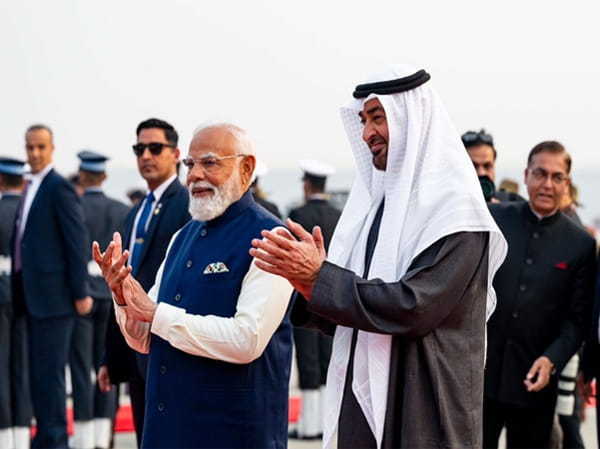
Indian Prime Minister Narendra Modi with UAE President Sheikh Mohamed bin Zayed Al Nahyan in New Delhi on January 19, 2026. | Indian Economic Observer.
❖ India must strive to matter to the greatest possible number of countries as either a critical supplier or a significant buyer of a specific commodity, service or product category for the other country. This will require creating industrial capacities but also necessitate a liberal market-access strategy for individual partners and business areas. Like certain others, India needs to instrumentalise market access – not by blind access-denial but by pragmatic market facilitation. This will enhance dependencies.
❖ At a strategic level, India needs to diversify markets beyond the US – for those export categories over-reliant on US customers – and diversify sourcing of intermediaries and components beyond China. The latter will entail making at home as well as finding other sources to cultivate. India could even consider making Chinese imports in some categories so significant that their displacement poses a risk to China itself. In the mid-19th century, the setting up of Indian textile mills by entrepreneurs such as Jamsetji Tata was opposed by the British textile industry but supported by British textile machinery manufacturers. Both lobbied the government in London with opposite petitions.
❖ The West facilitated manufacturing in China. China has no intention of doing the same in India. Even so, China covets the Indian market. There needs to be a trenchant identification of industrial sectors where market access is deemed permissible as a price for greater Chinese investments in local value-addition facilities and capacities. This should not be an across-the-board thrust, but a limited compromise, after a careful determination and with a whole-of-government clarity.
❖ Both the European Union and the ASEAN bloc are trapped between a coarsening US and an intimidating China. An opportunity exists for India beyond schadenfreude. Both those collectives are looking to India to expand their strategic autonomy. There is no reason why India cannot use them judiciously for the same purpose. Again trade, market access and supply chain interlinkages – including defence supply chain interlinkages – will play a role and will call for enlightened policy framing.
❖ As India builds its manufacturing, it will need steady commodities supply relationships with several countries: Australia and Indonesia to its east, Russia to its north, South American nations such as Peru and Chile, even Canada and parts of Europe. It will also need to focus on industries where opportunities are available and where it (India) has demonstrated ability. Refining of crude oil is one such strength. India’s expertise, price advantages and potential market stranglehold can make it possible to refine what Taiwan is to semiconductors. Strategic autonomy here requires not being bullied into which relationships to go ahead with and which to abstain from. It could also mean countering gaslighting in the form of stiff energy transition targets that nobody – not even Europe – can seriously meet.
❖ In key technologies – AI, quantum computing, the semiconductor ecosystem – India’s comfort and congruence is with the West and specifically with US partners. If preserving these relationships and sequestering them from political pressures entails market-access concessions towards Washington’s trade negotiators, it’s a bargain well worth it. It will more than pay for itself in the long run.
Conclusion
These six vectors describe India’s best-case scenario: growing strategic autonomy using a mechanism crafted by a nuanced exercise of strategic autonomy itself. Can India do it? Frankly, there is no choice in the matter. It must and it will. It would help of course if diplomacy were allowed to once more become the quiet, gritty, even boring calling it needs to be. Strategic autonomy is a long game, and Indian statecraft needs to accord the game that respect.
(Exclusive to NatStrat)

Separating Reality from the Rhetoric: Facts, Fiction, and the Indus Waters Treaty