

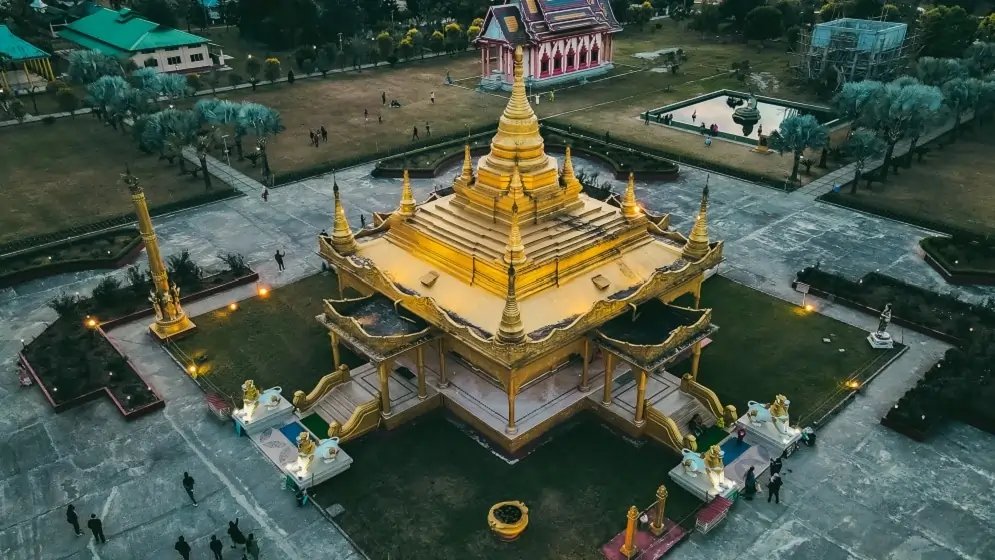
The Golden Pagoda in Namsai, Arunachal Pradesh | Website of the Golden Pagoda Marathon 2026

Today, India is visible more than ever in the Buddhist world, both as a developmental partner and as a practitioner of the Buddha’s principles in its statecraft. Given the state of the international order, India has emerged as a consensus builder, imbibing the Middle Path in letter and spirit. For India, Buddhism is more than just an element of soft power; rather, it is synonymous with India’s rise and its vision to reshape the global order and redefine the Asian century.
Introduction
For over two thousand years, Buddhism has influenced India’s civilisational identity and its linkages with Asia. Both Northern (Mahayana) and Southern (Theravada) Buddhism, which together characterise many Buddhist traditions across Asia, trace their origins to India. The significance of Buddhism was well recognised during the founding of independent India, when the Sarnath Lion Capital and the Dhammachakra in the national flag were designated as India’s national symbols. Independent India’s leaders made earnest efforts to reach out to the Buddhist nations. This outreach witnessed extensive scholarly exchanges and temple restoration projects across Southeast Asia. However, the 1962 India-China War and the broader dynamics of the Cold War limited the scope of this subsequent alignment for Indian outreach. Soon after the Cold War, India partnered with Russia and Mongolia on the rediscovery of their Buddhist heritage and traditions.
In 1991, India launched the Look East Policy. This policy envisioned Buddhism's institutional role in deepening ties with East and Southeast Asia. This is evident with the reinvigoration of the Look East Policy as the Act East Policy under the leadership of Prime Minister Narendra Modi, with Buddhism continuing to be a key aspect of it. Buddhism has increasingly defined Indian foreign policy and India’s engagement with its immediate obligations in South Asia, extended neighbours in Southeast Asia, partners in the rest of Asia, and its advocacy for an inclusive international order.
Turbulent events, including the Pahalgam terror attacks followed by Operation Sindoor, and political turmoil in Nepal and Bangladesh, have directly impacted India's interests. While India faces various strategic challenges from its ongoing developments, its neighbourhood and the global disruptions, India’s cultural and civilisational linkages, such as Buddhism, may play an instrumental role in strengthening ties with the rest of Asia. This is evident through the growing influence of Buddhism’s civilisational messages in India’s diplomatic, economic and strategic posturing. As part of its outreach strategy to Buddhist nations, India has intertwined its cultural diplomacy with its developmental initiatives in the neighbourhood.
Recently, the 2026 Union Budget announced a Buddhist Circuit connecting the Northeastern states. Arunachal Pradesh stands out for its diversity of Buddhist traditions as it is home to both the sacred Tawang Monastery, revered by the Tibetans and the Tai community of Namsai, which follows the Theravada tradition. The proposed scheme covers the preservation of monasteries and the development of pilgrimage sites with the aim of channelising India’s natural connections with Southeast Asia, as well as placing the Northeastern region “as an important destination on the global Buddhist tourism map.”
India’s Centrality to the Tibetan Question and His Holiness the Dalai Lama’s Succession
As a home to the Tibetan community-in-exile, India not only demonstrated its commitment to humanitarian values with its unconditional support for Tibet but also acknowledged the centuries-old links and its role in shaping Vajrayana Buddhism, which forms the basis of Tibetan identity. As the discourse over His Holiness (H.H.) the Dalai Lama’s succession intensifies and his assertion that his successor will be reincarnated outside of China, India’s role is quintessential in safeguarding Tibetan traditions.
The Dalai Lama’s 91st birthday celebrations in July 2026 once again underscore the significance of the Ganden Phodrang Trust, which is primarily responsible for succession. On the other hand, India faces the test of mobilising like-minded allies both in the Buddhist world and in the West in light of Beijing’s continued assertions that the next Dalai Lama shall be born in China.
India as a Global Platform for Buddhist Dialogues
India has also positioned itself as a global platform for Buddhist dialogues. Beginning with the India-Japan Buddhist Dialogue in 2015, India-led institutional conversations have taken on a global dimension in recent years. Launched in 2023, the Global Buddhist Summit, along with the Asian Buddhist Summit 2024, have invited senior-most monks and statesmen from the Buddhist nations to deliberate over common initiatives for the preservation of Buddhist heritage and culture across Asia.
Besides scholarly exchanges, the summits emphasised contemporary challenges to the global order and the significance of Buddhist philosophy in addressing them. In a way, these deliberations also position Indian values to contribute to the normative discourse on the international order. Such initiatives are unique opportunities to unite the Buddhist world around core values and to chart a common agenda for their preservation and promotion.
Institutionalising Studies and Research on Buddhism
To date, India is a centre of Buddhist studies for thousands of students, mostly from Southeast Asia. Interest has only grown with the ongoing discovery of relics and artefacts. India’s push to strengthen institutional ties with the Buddhist world is also reflected in the emergence of Nalanda University, under the aegis of the Ministry of External Affairs, as a world-class centre of learning. With full-fledged courses in Buddhism, International Relations, and related subjects, over two-thirds of Nalanda’s students are foreign nationals, an initiative that resonates with Nalanda’s traditional and cosmopolitan spirit.
Given Pali’s sacred status in Theravada Buddhism and its historical connection with many Southeast Asian scripts, its recognition as a classical language by the Government of India in 2024 is another such testament to India’s commitments.
The Government of India has increased institutional support to Buddhism through grants and research facilities under the Indian Knowledge Systems Division of the Ministry of Education. Such initiatives yield dividends that go beyond merely raising awareness about Buddhism and extend towards generating international partnerships and career opportunities for passionate researchers.
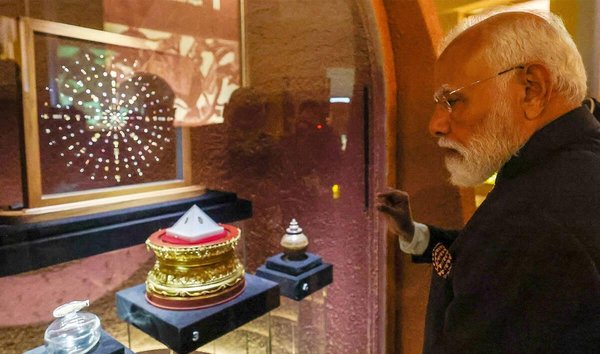
Indian PM Narendra Modi at the ‘The Light and the Lotus Relics of the Awakened One’ Exhibition in New Delhi | Press Information Bureau, Government of India
Battling Adversarial Narratives
While the contributions of other Asian nations to the diverse traditions of Buddhism are well acknowledged, there is growing concern about subversive narratives that undermine both Buddhism’s own history and India’s centrality to its origins and evolution. For instance, there is a deliberate attempt to complicate the understanding of the Future Buddha or the Maitreya Buddha, who is prophesied to reincarnate as a universal monarch in Ketumati (believed by scholars to be in Northern India only). By proliferating a narrative against these beliefs, long attested in Buddhist texts. New Delhi is also working hard to prevent Buddhist discourse from being entangled in a geopolitical contest, especially as China competes with India to proliferate its own version of Buddhism.
India has been a custodian of Buddha’s relics. The recent exposition of Buddha’s sacred relics in Bhutan and Sri Lanka was attended by millions and affirmed India’s commitment to deepening civilisational ties. In 2025, the Government of India prevented an auction of the Piprahwa relics, which are highly revered artefacts associated with Lord Buddha in Hong Kong, ensured their rightful return to India after 127 years and finally reunited them with Buddha’s existing relics in New Delhi. The reunion ceremony was celebrated as the “Light & the Lotus: Relics of the Awakened One” exposition, inaugurated by Prime Minister Modi.
Today, India is visible more than ever in the Buddhist world, both as a developmental partner and as a practitioner of the Buddha’s principles in its statecraft. Given the state of the international order, India has emerged as a consensus builder, imbibing the Middle Path in letter and spirit. For India, Buddhism is more than just an element of soft power; rather, it is synonymous with India’s rise and its vision to reshape the global order and redefine the Asian century.
[The article is exclusive to NatStrat. The views expressed by the author(s) are personal and do not necessarily reflect the views of the organisation.]
Separating Reality from the Rhetoric: Facts, Fiction, and the Indus Waters Treaty