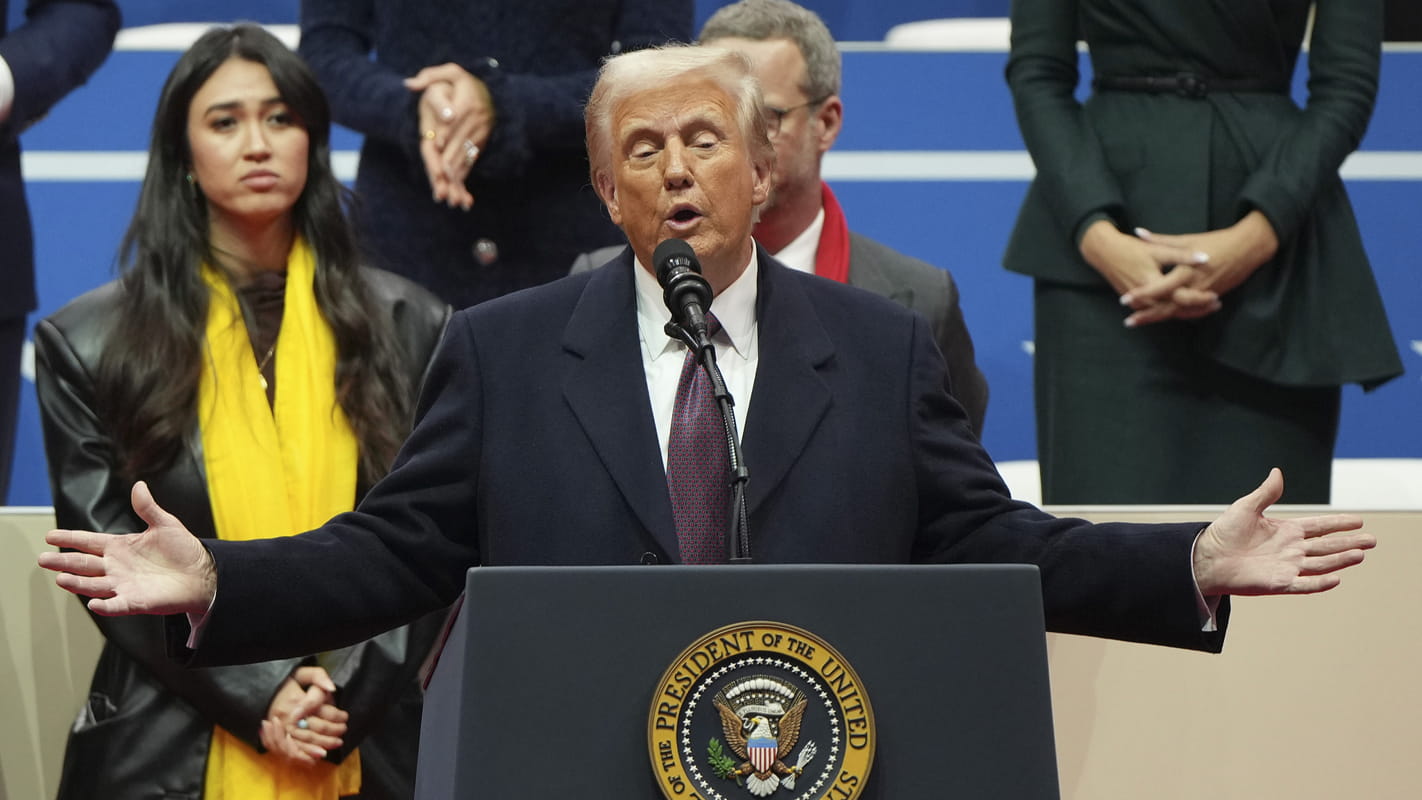


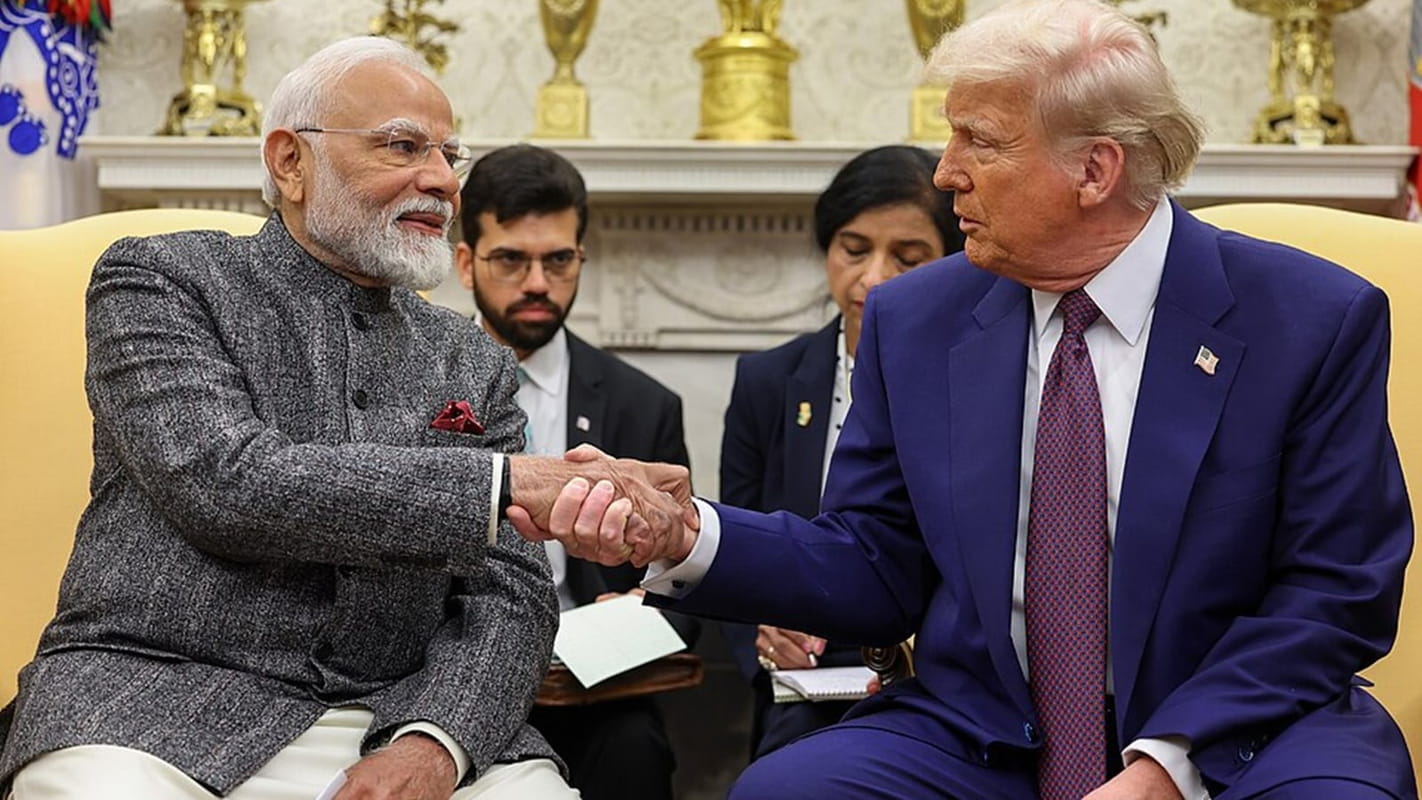
Indian Prime Minister Narendra Modi meets the President of the US, Donald Trump at the White House in Washington DC on February 13, 2025. | MEA.

Introduction
Strategic autonomy is a pillar of India’s sovereignty. Upholding sovereignty is both a constitutional requirement and a public mandate. India’s foreign policy has, in part, been crafted around economic, strategic and security requirements, accounting for the country’s endowments and capabilities at any given point in time. Keeping in mind short-term objectives and long-term goals, India has allowed strategic autonomy to take on various shapes and names through the country’s journey over the last eight decades.
As the technological and economic transformations of the 21st century alter the balance of global power, the geopolitical, trade and security landscape has become volatile. Uncertainty has grown. The number of variables that contribute to geopolitical outcomes has risen, and these variables are increasingly interrelated. In this context, sovereignty and national security take on new meanings.
As the world’s fastest growing major economy with a target of reaching developed status within two decades, India is resource hungry. To raise productivity and growth, the transition of labor from farm to factory is essential. In the face of rising neo-mercantilism practiced by China and the United States, India consequently pays special attention to unlocking new export markets, securing trade routes and accessing natural resources. Undergirding trade is an international financial system, one that has come under the strain of geopolitics in recent years.
Developing all-weather solutions to transacting, preserving and creating capital has proven essential to bolstering national security. Fractious international relations and proxy wars have raised the specter of armed and hybrid conflicts. The world is also rearming at the fastest pace since World War II against the backdrop of defense technologies breaching new frontiers. Therefore, building credible, indigenous military deterrence is as important as pioneering breakthrough dual-use technologies.
India’s path to developed nation status by mid-century involves ensuring sovereign control over determinants of growth, stability and security. The country’s three-decade window in which its demographic dividend plays out coincides with great power rivalry, deglobalisation, declining trust in post-World War II multilateral institutions, rapid technological advancements, global demographic aging, growing developed market sovereign indebtedness and a rising frequency in covert and overt conflicts.
Strategic autonomy will therefore continue to evolve in scope and scale, and in lockstep with national goals and national security requirements. Calibrated against current and expected changes in the dynamics of international relations and geopolitics, a nimble foreign policy is designed to secure India’s growth and re-emergence as a global economic, continental and maritime power.
Over the next twenty-five years, the GDPs of China and the US are expected to converge between the USD 37 and USD 42 trillion mark while India would reach around three fifths the size of the US.[1] It would mean that India would be where China is relative to the US in 2025. Because of its comprehensive national power, China is currently considered a near peer of the US despite a significant gap in per capita GDP.
Fractious domestic politics, relative loss of economic dominance and a strategic overstretch threaten the tenability of US-led unipolarity.[2] As the international landscape naturally shifts from unipolarity to multipolarity, cooperation based on converging interests will take precedence. India does not see the emergence of a new world order as a part of a zero-sum game in which the end state is unipolarity and full-spectrum hegemony of any one power. Navigating a turbulent transition phase marked by great power rivalry and risks of the Thucydides trap requires reformed multilateralism.
Therefore, India aims to be a stabilising, self-reliant, autonomous force that seeks mutual benefit through engagement rather than an actor which actively undercuts the development of others. Policymakers and leaders will, however, act when interests of any power impinge on national security and sovereignty. Altogether, New Delhi’s choices, dilemmas, and positioning highlight the continued salience and complexity of strategic autonomy. This article examines the doctrine’s meaning, its trajectory, and its layered economic, diplomatic, and security consequences, finally extrapolating the likely contours of India’s strategic autonomy in the coming decades.
Strategic Autonomy Defined
Strategic autonomy in India’s context refers to the capacity to:
❖ Pursue national interests independently, especially in foreign relations, defense, technology and economic policy.
❖ Actively engage a range of major global actors and institutions.
❖ Continuously develop comprehensive national power that ensures the country’s stability, security and growth. Unlike non-alignment, which symbolized in its ideal form, equidistance from power blocs and avoidance of entanglement, strategic autonomy is a dynamic strategy of selective, human-centric and interest-driven engagement.
It is a guiding principle of India’s international posture. Recent policymakers have transitioned from doctrinal abstraction to practical, modular engagement with leading global powers including the United States, Russia, China, and the European Union, technological powerhouses like South Korea and Japan, and emerging nations of the Global South. Should a rising power like India maintain this approach and forge robust partnerships, reformed multilateralism and re-globalisation will emerge.
When great powers which come dangerously close to conflict have a stake in India’s rise, New Delhi’s ability to mediate and create stability will become pronounced. As the country’s share of global economic output rises, this effect will be pronounced. India’s rise – driven in part by exercising strategic autonomy – is therefore, ultimately a net benefit for the international community.
India’s foreign policy transformation towards clearly defined strategic autonomy draws upon several approaches:
❖ Targeted de-hyphenation: Engagement with multiple states independently, not as derivative of one another unless an alliance impinges on core security interests.
❖ Modular Partnerships: Forming coalitions in specific sectors like security, trade, climate management, and development financing rather than comprehensive alliances.
❖ Multialignment: Simultaneous participation in diverse, sometimes seemingly rival multilateral forums.
Multidomain First-order Effects
Economics
India’s strategic autonomy has direct economic implications. By not binding itself to the procurement practices or regulatory constraints of any one bloc, India can negotiate technology partnerships, natural resource investment and procurement deals, defense ties and trade pacts keeping its core interests at center stage. The objective is to future-proof growth amidst geopolitical and economic volatility.
For example, diversification of commodity imports into Russian energy and minerals, Middle Eastern and US gas and oil, South American rare earths and Chinese battery components, enables India to meet multiple goals. It can simultaneously control inflation, trim its current account deficit, industrialise, and take steps towards building a greener economy. Alongside, reforms in domestic sectors such as mining, oil & gas production and minerals processing improve natural resource security against the backdrop of rising global protectionism and supply chain breakdowns. According to the International Energy Agency, India will be the largestsource of energy demand growth in the world by 2035.[3]
There are no energy-poor, wealthy countries and no large country has achieved developed status without industrialisation. Raising the contribution made by manufacturing to total economic output is critical for lifting living standards, raising purchasing power and shifting the consumption profile higher. All aspects of industrialisation – resources, technology and capital – are focus areas of India’s international multialignment.
Given India will continue to contribute nearly 20% to incremental global GDP growth,[4]for many years to come, outstripping much of the G7 combined, it is only natural that investors across the world seek to capitalise on this story. As pension systems in aging nations get strained, pension funds seek growth. Investing in US equities and bonds can take them only so far.
India remains a bright spot in the investment universe given the steady growth it can deliver. The deindustrialisation of many developed economies in Europe and East Asia also encourages businesses to scope out new opportunities. These firms are onshoring production in India and partnering with local firms as part of their expansion plans. Many of these same companies benefited from China’s growth over the last two decades.
Now that China is largely self-sufficient in several domains and its market is dominated by local brands, India stands out as the next big investment play. Furthermore, Free Trade Agreements create new commercial relationships which exploit both comparative and competitive advantages of India and its partners. Supporting these agreements is an understanding that the Indian economy will remain stable and deliver high compounded growth.
The economic and strategic imperatives of China and the US continue to weigh on free trade. The US faces rising debt while China’s economic growth depends heavily on exports. With these deep structural imbalances afflicting the two major powers of the world today, strings are increasingly attached to trading relationships. It risks tilting the strategic balance India seeks to maintain into a potentially unfavorable condition on both the economic and security fronts. India’s growth depends on building a balanced economy.
It will mean that domestic consumption should be met largely by local manufacturing, indigenous technology, and where possible, domestic natural resources. Simultaneously, the country must continue to provide a reliable stream of services and goods to the world and push for WTO reforms that ensure more equitable trading norms for developing economies.
Supply-chain resilience aligning with “Atmanirbhar Bharat” (self-reliant India) policies to boost manufacturing and reduce dependence on foreign technologies is a pillar of strategic autonomy. This is a work in progress which often involves partnerships with several firms that are materially important to developed economies.
Both indigenous innovation and joint industrial and technology projects enable India to climb the value chain, improve human capital, generate wealth and ring fence against external shocks. For foreign investors in the India story, this stability helps guarantee stable returns. By extension, New Delhi’s pursuit of strategic autonomy would deliver a net positive externality to these partners.
The rise of multiple currencies is a hallmark of emerging multipolarity. As India’s trade with the world grows, the country must internationalise its currency. It improves financial stability and reduces uncertainty related to foreign currency holdings. Critics argue that such a move is a concerted attempt to undercut the international monetary system in place for the last eight decades. However, the underlying reason for currency diversification lies in India’s rising share of global trade amidst high global indebtedness and materially significant risk of financial asset seizures.[5]
Europe, China, the US, Japan and India are at unique stages in their economic development. Their financial obligation profiles, or debt to GDP ratios vary, with India being the least leveraged. Their respective growth rates and domestic economic conditions are distinct. Debt pressures have resulted in significant debasement of fiat currency and volatility in prices of developed market sovereign bonds. The negative impact on India’s foreign reserves is significant.
Flight to quality, including gold, investments in hard assets, and internationalization of the Indian Rupee are three means to preserving wealth, and is part of India’s expression of strategic autonomy. Financial stability will depend on the country’s ability to get ahead of the curve of fiat debasement.
Security
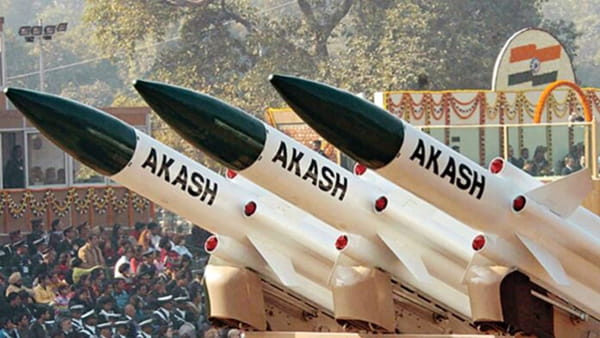
Akash Missile System, India's first fully indigenous surface-to-air missile (SAM) system on display at Republic Day parade in 2025 in New Delhi. | Indian Aerospace & Defence Bulletin.
Security dimensions form a critical core of strategic autonomy. India hedges against threats across contested borders and maritime trade routes by strengthening indigenous defense capabilities and maintaining flexible international security cooperation. Russia, France, the US, Israel, Germany and several regional partners will remain important partners in India’s security collaboration matrix.
Defence hardware co-development and production, military-technical joint work, and shared R&D in target areas prove financially, technologically and strategically important for all involved. By focusing on interoperability in specific domains, India resists pressure to join formal military alliances, favoring sectoral cooperation, joint exercises, and intelligence sharing without treaty-bound obligations.
Nuclear autonomy is preserved through its no-first-use doctrine, robust second-strike capabilities and abstention from external security guarantees. Altogether, India becomes a trusted partner which operates within the framework of an India-first policy that benefits its defense and technology partners. Geographic location is critical given the country’s growing role as a security guarantor in the Indian Ocean Region. Deftly managing multiple international relationships expands the set of converging interests that members of traditionally competing blocs can possibly have with India.
Defense modernisation – which began with large scale, often single-source imports – will increasingly depend on innovation and adoption of indigenous equipment. The notion that India will remain dependent on imports for decades to come does not fit with the adaptive nature of its strategic autonomy. The annual national defense budget will likely touch USD 170 billion by 2035 and USD 350 billion by 2045.
A growing share of this will be dedicated to hardware, R&D and testing. To make this expenditure economically and strategically sustainable, the long-term objective is to produce all critical platforms, systems and subsystems at home, harnessing indigenous intellectual property. Deploying this hardware at scale and participating in the export market reduces costs and earns revenues.
Modernising while also reducing dependencies is a journey on which reliable suppliers and technology partners are welcome to engage with New Delhi and capture financial opportunities for a finite period. Simultaneously, interoperability will likely remain a consistent theme that keeps international defense cooperation on a firm footing. New Delhi places special emphasis on freedom of navigation and trade for all, and through its global defence partnerships, can contribute to strengthening the security architecture of the Indo-Pacific.
Dual use and non-military technologies are fast becoming critical to national security. Social media platforms, space technologies, data centers, next generation communication systems, semiconductors, electronic components, AI models and quantum systems stand out as areas where India seeks to develop self-reliance in a step-by-step manner. Sovereign control over what some may term “digital supply chains” is as important as a native, full-stack hardware ecosystem that serves domestic needs.
As supply chains adjust to a push for onshoring, reshoring and friendshoring, India prioritizes international collaboration based on equitable, mutually beneficial trade and a steady increase in domestic value addition. Mirroring global trends, industrial policies naturally follow to energise both innovation and scale buildout in strategically important areas.
Diplomacy
Diplomacy under strategic autonomy balances ties. It ensures that partners appreciate both modular engagement and India’s approach to building a reformed multilateral system.[6] For instance, India’s non-prescriptive participation in the Quad is balanced by active roles in BRICS and SCO and supplemented by engagement in the G20 and several regional groupings.
Simultaneously, bilateral ties with several member states fine tune and optimise relationships for mutual benefit. New Delhi’s diplomatic outreach will therefore grow in scope and depth as the set of deliverables widens in line with the country’s economy, capabilities and expected development path. Importantly, India aims for broad international consensus for reform of global institutions.
This includes UN Security Council expansion, World Trade Organisation equity for the Global South and deeper ties across G20 countries, all in the pursuit of pluralistic multipolar restructuring. What is sometimes perceived as strategic ambiguity on contentious issues including armed conflicts between third parties is not a knee-jerk reaction to the dismissive approach that some prominent members of the international community display towards India’s own security concerns.
Rather, it is about redefining diplomacy with the aim of derisking across all major domains of India’s international relations. This enables New Delhi to safeguard national interests while retaining negotiating leverage. Expectedly, the diplomatic capabilities of the country will expand as the complexities of multipolarity and multialignment take on new forms.
Second Order Effects and Challenges
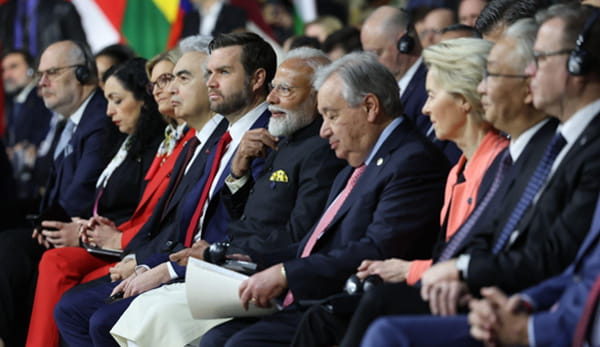
Indian Prime Minister Narendra Modi is seen here along with other world leaders in Paris where he co-chaired the AI Action Summit on February 11, 2025. | MEA.
In the run up to the middle of the century, India will project itself as the primary net security provider and developmental partner spanning East Africa to Southeast Asia. This would provide an alternative and stable development path to what China offers through the Belt and Road Initiative. It aims to help countries in the Global South earn an opportunity to hedge, and exercise within their constraints, strategic autonomy.
This will strengthen India’s neighborhood-first approach, focusing on connectivity, reviving cultural exchange and rebuilding Asian trade routes which better reflect the growing presence of India at the crossroads between West and East Asia. Given the vast array of interests at play in the region and beyond, deft diplomacy will be required to make this sustainable. Developed nations that invest in a collaborative effort with India in financing and capacity building across the region can contribute to rule-setting and therefore, regional stability.
The path towards this goal involves navigating often strained regional and global relationships. When regional demands conflict with India’s global balancing, New Delhi’s diplomatic capabilities must match the moment.
On a larger level, India’s approach to strategic hedging challenges global power expectations, especially Washington’s desire for closer defense alignment and dependency, while also preventing Moscow and Beijing from viewing New Delhi as an unequivocal Western ally. Such hedging enables India to maximise transactional gains from competing powers, but this can lead to diplomatic friction, as demonstrated by divergent responses to the Russia-Ukraine war and regional conflicts in Asia, including the Indian subcontinent.
The solution lies in rapid development of indigenous capabilities. This reduces dependencies and fosters balanced bilateral relations. That said, the constraints here are significant. Technology innovation, capital creation and human capital development take time to mature. Meanwhile, as multialignment broadens India’s export markets and foreign investment flows, persistent trade frictions with certain Western and Eastern partners pose risks for sustained economic growth. Domestic reforms covering agriculture, the bureaucracy and land can raise efficiency and productivity, thereby opening new avenues for growth.
However, political constraints may hamper reforms. As a result, foreign policy maneuverability can face serious limitations. India’s push for indigenous technological capability and supply-chain independence, while a resilience strategy, might also slow high-tech sector integration absent greater external partnerships. Navigating these challenges will test New Delhi’s resolve, the acumen of regional leaders at the state level, and the speed with which the bureaucracy can execute plans.
Over time, India’s strategic autonomy has the potential to reshape global models of partnership, providing a template for what multilateralism can look like in a world in which the center of economic gravity shifts from the North Atlantic to the Indo-Pacific. By refusing zero-sum alignments, India may catalyse new forms of coalitional diplomacy, especially among medium powers.
The demand for democratisation of global institutions and participation in setting rules for next generation technologies will intensify, leading to increased friction with status quo powers but also opportunity for collaboration with rising actors. Participation in modular, issue-based coalitions will proliferate, yet overlapping and sometimes contradictory commitments may invite criticism or doubt regarding reliability, consistency and sustainability.
The multiplicity of engagements requires agile management. The risk of overstretch is real if conflicting commitments get rival coalitions to materially pressure India for alignment. The possible denial of critical technologies, access to global banking channels, trade opportunities and trade routes, remain major concerns. Such risks would be magnified should Indian growth stall, conflicts between the West and Russia-China axis come to a head before India reaches a critical economic mass, and domestic reforms are found slow to pass.
Pursuit of regional and global hegemony by major powers has deeply damaged traditional rules of engagement, debased diplomatic protocol and eroded trust. Hedging against this by building autonomous security capacities will likely spur indigenous innovation. In the long run, this could fundamentally transform the global security architecture by placing India as a pole in a multipolar world. India’s nuclear policies, cyber defense initiatives, and space ambitions stand to enhance deterrence and strategic influence, but increased complexity in threat management, especially in technology-enabled grey-zone warfare and proxy conflicts will test New Delhi’s diplomatic adaptability and precise applications of locally made systems.
An Evolving Paradigm
The intersection of technology, trade and finance will determine the constraints and opportunities for major and emerging powers. As global debt reaches unprecedented levels and nations face aging demographics, the pressure to unleash new productive forces mounts rapidly. Imbalances in trade can in part be resolved by production automation and AI.
However, access to natural resources will become a major bottleneck. As the world transforms and India grows, the contours of the country’s strategic autonomy will evolve. To compound high growth from high absolute GDP levels down the line, preserving international maneuverability becomes a national imperative. That can be achieved by maximising domestic capabilities.
Many of these can be built through relations based on the need of others to strategically hedge. Afterall, the world of “with us or against us” has passed its expiration date.[7] Special focus will be maintained on securing trade routes, co-developing production and defense technologies, accessing a reliable stream of commodities and building an internationalised currency.
Going forward, policymakers will continue to refine this doctrine, balancing autonomy with partnerships and national interest with global responsibility. The challenges are formidable – the complexity of global expectations, a wide range of internal capacity constraints and disruptive geopolitical shifts – but the logic behind strategic autonomy remains robust and central to India’s growth and the world’s stability.
(The article is exclusive to NatStrat. The views expressed by the author(s) are personal and do not necessarily reflect the views of the organisation.)
Endnotes:

Separating Reality from the Rhetoric: Facts, Fiction, and the Indus Waters Treaty