

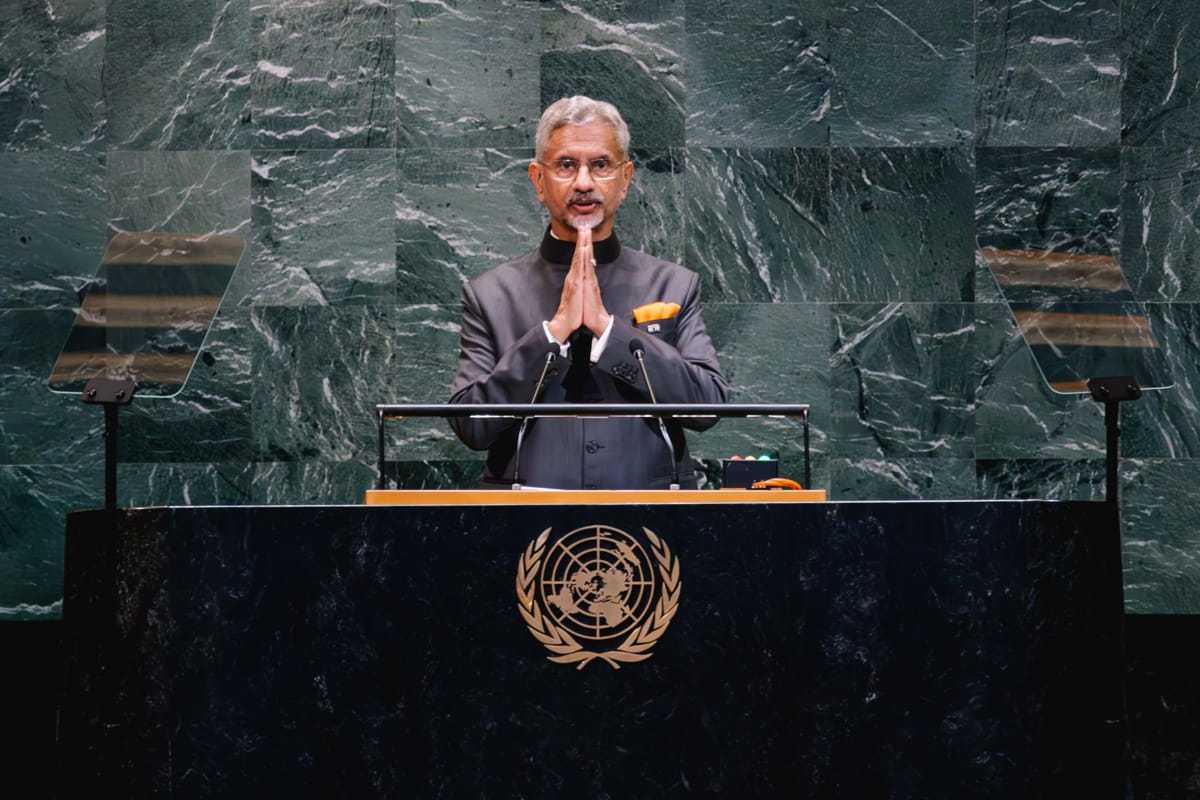
Indian External Affairs Minister S Jaishankar greets the 80th session of the United Nations General Assembly on September 27, 2025 in New York. | Bharat Express.
Consequently, given the sui generis situation India is in, instinctively or by design, strategic autonomy is the default mode of Indian strategic thought. There is no reason to deviate from this since it has served India well. However, there is definitely a need to effectively utilise the space created with our policies and have a sharper focus on achieving our goals, including providing leadership. This is crucial to navigating the global churn.
Historical Evolution
Strategic autonomy, in simple terms, is the creation of space by countries for independent decision-making in accordance with their national interests. India has traditionally been a country that has fiercely defended its strategic space. This should not surprise us.
Without trying to unduly glorify the past, we need to acknowledge that, as a civilisational power, India has had a plethora of texts over the centuries, such as the Arthashastra, Nitisara, Shukra Neeti, and Tirukkural, among others, which laid down normative standards for statecraft and geopolitics.
This was reinforced by our struggle for independence, during which Mahatma Gandhi drew from our texts and philosophy, and fashioned unique but practical tools – Satyagraha and Ahimsa (truth and non-violence), to throw the British out.
Another historical overlay was the contribution of Buddhist thought and philosophy to our collective thinking. Without turning our backs on the West, India as a colony, also imbibed Western notions of nation-states and international norms of conduct. Consequently, there was an unmistakable impact of history on our thoughts on statecraft and international relations, which shaped our post-independent posture of strategic autonomy.
It was, therefore, no surprise that at the turn of our independence, Prime Minister Nehru envisaged active engagement with world problems without joining either of the two Cold War camps and took an independent stand. This was nothing but expanding the strategic space for India without giving it a name. Newly independent countries looked for options other than becoming superpower camp followers, and India offered a way out. Non-alignment shaped the thinking of much of the developing world for decades.
In many ways, strategic autonomy for India was a given since it was deeply embedded in our psyche. India did not become a treaty alliance partner of any of the major powers. Whether as a leader of the Non-Aligned Movement, or as a nuclear power, or the fourth-largest economy, or as a country contributing to global good and the global commons, India charted its own path. And it served us well.
Strategic Autonomy and Leadership
Further, strategic autonomy is also about leadership. Non-alignment not only gave us the strategic space to make independent decisions but also propelled us to the leadership of the developing world. The developing world saw in India a nation that could offer a third option and not kowtow to the dictates of the superpowers. Therefore, many of those questioning India’s policy of strategic autonomy do not appreciate the fact that it is as much a path towards leadership as it is a means of autonomy in decision-making.
Only a country that makes independent decisions can offer alternatives to other countries. Questioning India’s quest for strategic autonomy is to question India’s quest for leadership and contemporary India’s potential re-emergence as a civilisational force.
India’s recent policy of multi-alignment is focused on much of the same objective – achieving strategic autonomy in a globalised world, where even adversaries are closely interconnected and conduct intense business with each other. It is a pragmatic and necessary policy – an evolution to suit contemporary realities. Multi-alignment helps India navigate the inter se contradictions between its friends and ensure that its national interests are met. While it continues to serve India well to protect its strategic space, multi-alignment, unlike non-alignment, is not a recipe for leadership per se. This is a matter that needs to be specially addressed. And why is leadership necessary for strategic autonomy?
When India has global ambitions of its own, multi-alignment by itself is not enough, especially when the world is undergoing geopolitical churning.
In a fragmenting world order, geopolitics, threats and protectionism are determining economic and technological outcomes, not the Most Favoured Nation (MFN) status, nor free trade, nor the World Trade Organisation (WTO) led trade norms. Therefore, to get its economic and technological trajectory right, and protect its strategic space, India needs to get its geopolitics right.
Geoeconomics and Geopolitics
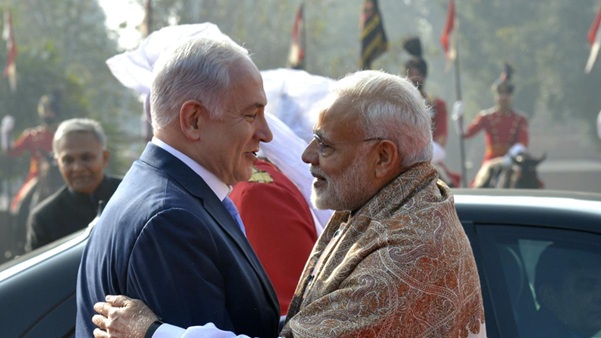
Indian Prime Minister Narendra Modi greets Israeli Prime Minister Benjamin Netanyahu at the Presidential Palace in New Delhi on January 15, 2018. | The Hindu.
In the last two decades, India has, rightly, prioritised economic growth, both under the United Progressive Alliance (UPA) Government and the earlier National Democratic Alliance (NDA) Government. This catapulted India to the fourth-largest economy. Having reached there, some argue that India should do more of the same, that is, keep its head down and focus on becoming the third-largest economy.
The argument is that a larger geopolitical role may hurt India’s economic growth. That template is now broken. In fact, the contrary is true. While it is no one’s case that India should not focus on its economy, the path to becoming a bigger economy is through getting the geopolitics right rather than merely playing by MFN rules.
In other words, to get its geoeconomics right, India needs to be much more proactive to protect and expand its “geopolitical elbow room”. The bigger India becomes, the greater will be its stakes in the outcome of global conflicts.
However, India had been largely silent on the Israel-Gaza War or on the Israel-Iran conflict and American bombings in June 2025, though we have important relations with all these parties, including our proximity with Israel, principled stand on Palestine, funding of Chabahar Port in Iran and numerous stakes in the Gulf. Although India rightly abstained from UN votes on the Ukraine conflict, we have failed to stay engaged with the war. Our overall approach of not taking a proactive stand on global conflicts and remaining on the sidelines is hurting our larger interests and impacting our strategic autonomy. Operation Sindoor shows us that if we seek greater engagement by our partners with our conflicts, we need to engage more with their conflicts and issues.
In fact, the international community expects us to play a global role, especially when we are aspiring for the permanent membership of the UN Security Council (UNSC). If, in the UNSC, India claims that decisions are not credible without permanent participation of India, then this logic applies equally to decisions taken outside the narrow confines of the Security Council.
The flip side is that if we do not meet these expectations, we are ceding strategic space to countries like Türkiye, Saudi Arabia, Qatar, or Italy to tackle conflicts globally, whether in Europe, the Middle East, Africa, or the Indo-Pacific, where our stakes are high. Not all of them necessarily have India’s interests in mind. We are already witnessing the growing profile of Pakistan in the US and the Gulf (with the signing of the Saudi-Pakistan Mutual Defence Agreement), and countries like Türkiye moving in to fill the vacant space, presenting us with a fait accompli detrimental to us. Thus, not taking a proactive role in global conflicts will also adversely affect our strategic autonomy in decision-making.
The question is not whether we need to re-examine our policy of strategic autonomy, but whether we have been able to expand that space and use the opportunities created by such a policy to achieve our ends. This is where our record has been uneven.
For example, in both the WTO and the United Nations Framework Convention on Climate Change (UNFCCC), Indian negotiators have negotiated hard to buy more time to meet our developmental milestones but we have not been able to capitalise on it. In textiles and clothing, we won a hard-fought battle in the WTO and got more time – strategic space – but during that extended period, we failed to reform the sector, leaving us well behind competitors like Vietnam or Bangladesh.
We have had a somewhat similar experience with climate action. China, for example, used the extended period to embark on a high-carbon growth trajectory for development, whereas India failed to use the same window to utilise our quota of the carbon budget for our development. As we witnessed at the UN Climate Change Convention Conference of Parties in Belém, Brazil in November 2025, this strategic space is shrinking with pressure on India to phase-out coal – something not immediately feasible.
Conclusion
Consequently, given the sui generis situation India is in, instinctively or by design, strategic autonomy is the default mode of Indian strategic thought. There is no reason to deviate from this since it has served India well. However, there is definitely a need to effectively utilise the space created with our policies and have a sharper focus on achieving our goals, including providing leadership. This is crucial to navigating the global churn.
(Exclusive to NatStrat)

Separating Reality from the Rhetoric: Facts, Fiction, and the Indus Waters Treaty