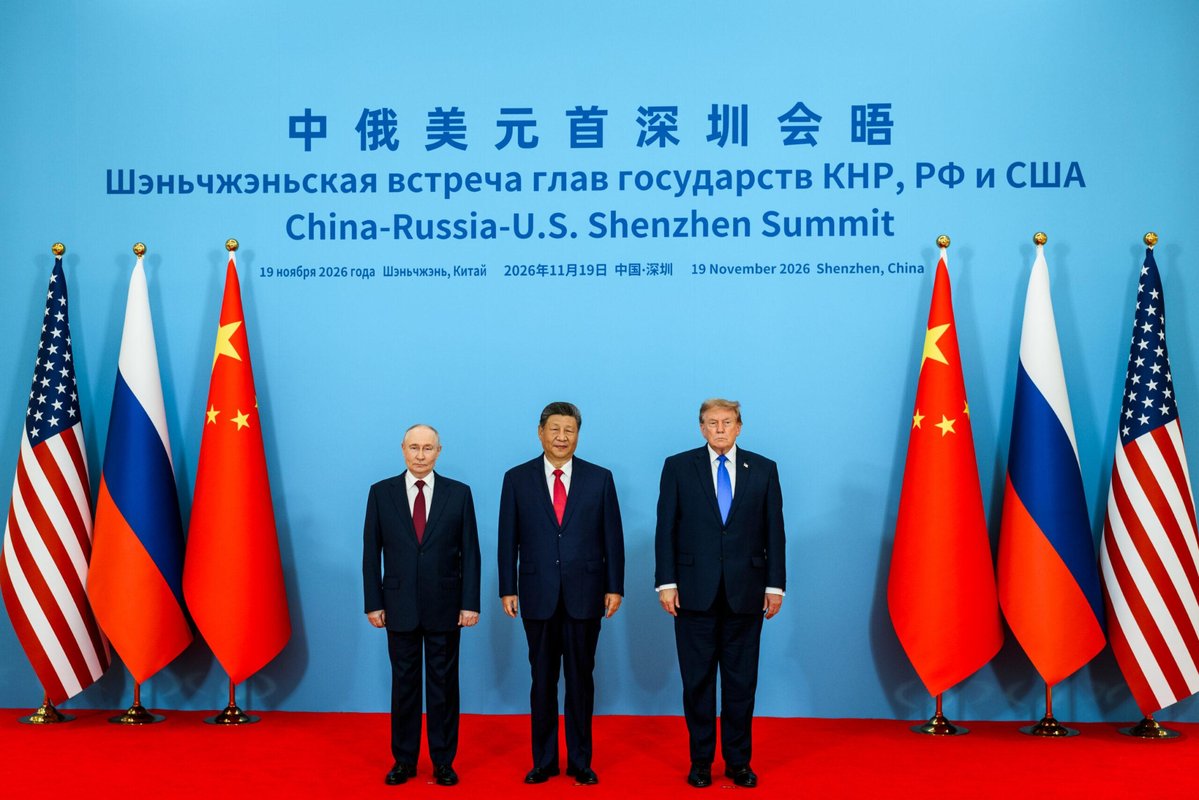
China-Russia-US Shenzhen Summit| US Embassy & Consulate in China

The China-Russia-US Trilateral
The first-ever great-power trilateral meeting between US President Donald Trump, Russian President Vladimir Putin and Chinese President Xi Jinping, held in Shenzhen, China, on 19 November 2026, has inevitably invited comparisons with the 1945 Yalta Conference among strategic thinkers globally. The coming together of the three most powerful countries is undoubtedly a historic geopolitical development. However, while Yalta addressed some of the most difficult questions confronting the international order at the end of the Second World War, the joint declaration emerging from Shenzhen appears to have settled for some of the safest and most convenient outcomes that could have emerged from a summit of this grandeur.
The four-point Declaration toward Peace, covering UN reforms, energy security, the jurisdiction of international institutions and nuclear risk reduction, identifies areas where the three powers can find common ground. Yet it deliberately leaves unanswered the tougher questions that define their strategic differences. In many ways, the declaration is less about resolving existing conflicts than about establishing a common understanding among the three powers on issues where their interests do not directly collide.
Pillar I: The UN and the Question of Global Governance
As the first of the four declarations, the commitment to reform the United Nations may seem the most consequential. The UN Security Council has increasingly found itself paralysed by geopolitical rivalries, particularly among the three permanent members. Since 2022, the year when the Russia-Ukraine War began, 29 resolutions have been vetoed by the permanent members, that too, by Russia(16), the US(8), and China(5).
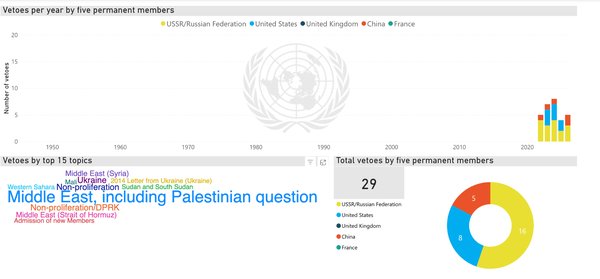
Number of Vetoes in UNSC since 2022| Website of United Nations Security Council
These deadlocks reflect disagreements not only over Ukraine, but also on issues of grave geopolitical significance, including Gaza, Syria, Sudan, and non-proliferation. The inability of the UNSC to respond effectively to several ongoing conflicts has raised serious questions about its relevance and effectiveness. If three of its most powerful members now agree that the organisation needs reform, the prospects of institutional change may appear more plausible. However, the declaration offers no indication of what these reforms might entail. It does not mention expanding permanent or non-permanent membership, making the institution more representative, or democratising its decision-making processes.
Whether such a reform would accommodate the aspirations of countries including India remains an open question. The more immediate significance is that the three permanent members have collectively acknowledged the need to revisit the existing structure of global governance. What kind of UN they envisage, however, remains unspecified.
Pillar II: Energy Security and Convergence of Three Different Interests
The second commitment in the declaration concerns energy security and production. The energy crisis instigated by the Russia-Ukraine War and later amplified by the conflict in West Asia is being experienced worldwide. At a time when energy security has become a major concern across regions, the three countries approach energy security from very different strategic positions.
For the United States, expanding domestic energy production and strengthening its position as a major global energy supplier have been important policy objectives. The rationale behind its recent political and military interventions towards Venezuela and Iran has been viewed against the larger backdrop of energy geopolitics. In the case of Venezuela, the toppling of the government was comparatively smoother; the conflict with Iran does not seem likely to end soon. The war and the disruption of maritime routes have further demonstrated that vulnerable global energy supplies not only amount to geopolitical instability outside but also affect America. As per the latest data from the US Energy Information Administration (EIA), the gasoline price is around USD 4.153 per gallon. The analysts suggest that, for the first time during Trump's second term, the national average price of gasoline has exceeded the average recorded over President Biden's entire four-year presidency.
For China, the issue is equally important but from a different perspective. China has recognised that energy security cannot be guaranteed through diversification of suppliers alone (largely access to the Russian market), it also requires the securing of the maritime routes connecting those suppliers to its economy. With approximately 40–50% of crude oil and 30% of LNG imports from the Strait of Hormuz, the disruptions to shipping through strategically important sea lanes, particularly in the wake of the Iran conflict and the vulnerability of the Strait of Hormuz, have reinforced concerns for China. Beijing would naturally want assurances against further disruptions to global energy flows.
Russia, meanwhile, desperately needs to maintain access to international energy markets. Its ability to sell oil and gas remains an important source of revenue, particularly amid the economic pressures and sanctions imposed following the war in Ukraine. Whether this emerging understanding translates into some sort of relief from sanctions or a change in the international energy trade regime is something the world will be watching.
The declaration has not specified any arrangements for energy trade, sanctions relief, investment or the distribution of supplies. It merely identifies stable energy flows as a shared interest. Nevertheless, the fact that three countries with very different energy priorities have found common ground on this issue is significant.
Pillar III: The International Criminal Court and the Politics of Sovereignty
The third point addresses state consent, immunity for state officials and the jurisdiction of the International Criminal Court (ICC) and similar bodies; it is perhaps the most politically convenient area of agreement for all three leaders.
When it comes to the actual power and authority of international institutions, they become subject to the engagement and blessing of the great powers. A historical parallel worth examining here: the League of Nations, although conceived as an instrument for maintaining international peace, gradually became ineffective in the face of competing interests among the biggest powers of the time. US President Woodrow Wilson was among its strongest advocates, and the idea was central to his vision of the post-World War international order. Yet, the United States itself never ratified the Covenant of the League of Nations. Japan and Germany subsequently withdrew, while the Soviet Union was expelled in 1939 following its invasion of Finland. This ultimately led to the League of Nations' erosion.
The lesson was that an international institution, however ambitious its founding principles, cannot function effectively without the sustained commitment of the great powers. The ICC today presents a different institutional context, but its relationship with state sovereignty has once again brought major powers into a common conversation.
The United States has long questioned the Court’s jurisdiction over its nationals and has opposed proceedings that it considers an infringement of its sovereignty. Russia has faced an ICC arrest warrant against President Putin over alleged war crimes in Ukraine. Such warrants have created diplomatic inconvenience for Putin in the past. In 2025, he could not attend the G20 summit in Johannesburg because, as a signatory to the Rome Statute, South Africa was under obligation to act on the ICC arrest warrant.
China, which is not a party to the Rome Statute, has also consistently emphasised state sovereignty and non-interference. There are, therefore, different interests for each country to question the jurisdiction and reach of international institutions. The United States’ military actions and policies towards Iran, the controversy surrounding its interventions and its approach towards international legal accountability, along with China’s maritime and territorial disputes in the South China Sea and East China Sea, have all generated questions about the limits of state power and international jurisdiction. Mentioning “other similar bodies” also makes it open to interpretation and applicable to any international arrangement that causes/may cause inconvenience.
Nevertheless, the three powers have found a common language in emphasising state consent and immunity. This convergence is convenient because each has reasons to resist what it perceives as the excessive reach of international institutions. The larger question is whether this represents a genuine effort to clarify the limits of international jurisdiction or an attempt by powerful states to insulate themselves from international scrutiny.
Pillar IV: Nuclear Security: The Safest Common Ground
The fourth commitment concerns nuclear weapons and the prevention of nuclear escalation. The three leaders have reiterated that a nuclear war cannot be won and must never be fought, while agreeing to initiate dialogue on reducing nuclear risks and preventing proliferation.
This is perhaps the least contentious area of agreement. All three countries understand the catastrophic consequences of nuclear escalation, particularly given their respective nuclear capabilities. Personally, for Trump, though, the consensus on nuclear security through this platform works as a way of endorsing the legitimisation of his bombing of Iran when he and his administration are facing heat within the United States and among allies for the unfavourable outcomes and overextension of the conflict.
Beyond this, the question is whether this understanding will translate into a meaningful restraint on nuclear proliferation or the emergence of new international norms that would actually lead to arms-control arrangements, greater transparency and confidence-building measures. Will it address the expansion of nuclear capabilities and the growing complexities of strategic deterrence?
Three Great Powers: Three Geopolitical Calculations
Beyond the four commitments, the meeting also needs to be understood through the domestic and international political calculations of its three participants.
For Donald Trump, the summit fits into his larger approach to diplomacy, which places considerable emphasis on personal relationships, high-profile engagements and claims of historic breakthroughs. He has consistently projected himself as a leader capable of bringing adversaries together and delivering peace through direct engagement.
However, the domestic political environment has become increasingly challenging for his administration. The Republican setbacks in the November midterm elections, with Democrats winning control of both chambers of Congress, have constrained his political position. His economic policies, particularly tariffs and their implications for inflation and the cost of living, have attracted criticism. The military confrontation with Iran has also generated domestic opposition, while the continuing controversy surrounding the Jeffrey Epstein matter has added to the political pressures confronting his administration.
Trump now has approximately two years left in the White House. The coming year will be particularly important because political attention will gradually shift toward the 2028 presidential elections and the possible Republican candidates who may eventually receive his endorsement. Since he cannot contest another presidential election, the question of his political legacy will become increasingly important. The coming year will therefore be particularly important for him to establish the “Trump legacy” which has been the core of his political agenda.
His ambition to be remembered as a “peacemaker” and the leader who could bring the world’s most powerful countries together is likely to remain central to his diplomatic approach. The Shenzhen declaration can be seen as one such attempt. More high-profile meetings, dramatic diplomatic initiatives and declarations may well follow.
For Vladimir Putin, the meeting has a different significance. Russia’s international position has been under considerable strain since the invasion of Ukraine. The war has imposed enormous economic, military and diplomatic costs, while sanctions and continuing difficulties on the Ukrainian front have presented Moscow with significant challenges. Yet, Putin’s participation in a trilateral summit with the American and Chinese presidents reinforces Russia’s identity and recognition as a great power. It sends a message that, despite its difficulties, Russia remains an indispensable actor in determining the future of the international order.
For Xi Jinping, the meeting is an important moment of diplomatic recognition. Hosting the two other leaders in Shenzhen allows China to project itself not merely as an emerging economic and military power, but as a country capable of convening the world’s most powerful states. It is, in many ways, a symbolic crowning of China’s position in global politics. The country that has spent decades seeking recognition of its place in the international order is now sitting at the same table as the United States and Russia to discuss the future of that order.
The Questions Deliberately Left Unanswered
Perhaps the most striking aspect of the declaration is not what it contains, but what it leaves out.
The war in Ukraine, the conflict with Iran, tensions in the South China Sea, territorial disputes, sanctions and the future of regional security arrangements do not find any place in the final four-point document. This is particularly significant because these are precisely the issues on which the three countries have substantial differences.
It is worth clarifying that Ukraine and Iran were mentioned in Trump’s opening remarks, while Putin also referred to Ukraine during his remarks. Trump indicated that the two leaders had already discussed the war in Ukraine. However, these discussions did not translate into any specific commitment or conflict-resolution framework in the joint declaration.
The absence of technology, particularly artificial intelligence, is another notable omission. At a time when technological competition increasingly defines relations between the United States and China, and when artificial intelligence is becoming central to economic and military power, excluding this subject is significant. It suggests that the trilateral understanding was deliberately confined to areas where a broad consensus could be achieved.
More importantly, despite being titled a declaration toward peace, the document does not explain how the three countries intend to address the conflicts currently unfolding internationally. It offers no roadmap for bringing warring parties to the negotiating table, no framework for resolving territorial disputes and no indication of how the three leaders intend to contribute to specific peace processes.
From G2 to G3: Who Sets the Rules of the International Order?
For more than a decade, discussions about the emerging international order have revolved around the possibility of a G2 arrangement, with the United States and China exercising disproportionate influence over global affairs. The Shenzhen meeting introduces a different possibility: a G3 understanding in which the three permanent members of the UN Security Council seek to establish common positions on selected questions of global governance.
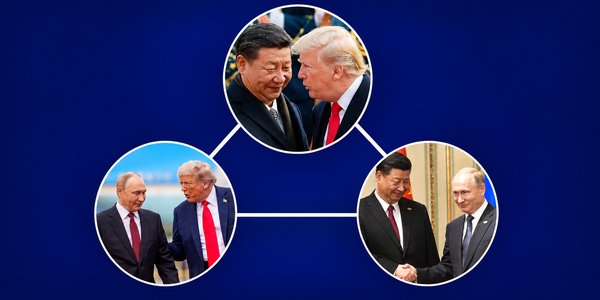
A G2 or a G3 Scenario?| Generated using AI (ChatGPT)
The three leaders have different messages to convey. The United States is signalling that, despite the emergence of new powers and the challenges to its global influence, it continues to see itself as a central force in determining the international order. Despite the economic and strategic difficulties it faces, Russia is asserting that it remains part of the great-power club and cannot be excluded from decisions on global security. China, meanwhile, is demonstrating that it has arrived as a great power and intends to have a decisive say in shaping the future of the international system.
The Shenzhen Declaration, therefore, may not be a Yalta moment in the traditional sense. Yalta was about negotiating a post-war settlement and making difficult decisions about the future of Europe and the international system. Shenzhen, by contrast, has produced a limited understanding of four issues where the interests of the three powers converge, while leaving their most contentious disagreements unresolved.
In the Declaration towards Peace, the three powers are not necessarily agreeing on how the world should be governed. Rather, they are asserting that the rules, institutions, and norms governing the international system cannot be discussed without their participation. For now, the declaration offers a glimpse of an international order in which the present great powers increasingly seek to negotiate among themselves, even as the conflicts and concerns of the rest of the world remain largely outside the room. Ultimately, the symbolism is unmistakable: the US, China, and Russia—the three Great Powers of this time—may compete yet accommodate one another, and they share one fundamental message through the summitry in Shenzhen: ultimate power resides with them, and they intend to keep it that way.
[The article is exclusive to NatStrat. The views expressed by the author(s) are personal and do not necessarily reflect the views of the organisation.]
From Abeyance to Abrogation: Why the Indus Waters Treaty Now Needs a Statute
Separating Reality from the Rhetoric: Facts, Fiction, and the Indus Waters Treaty