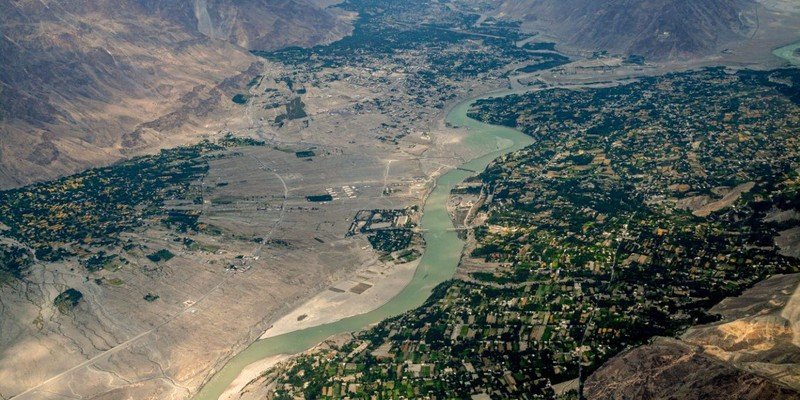


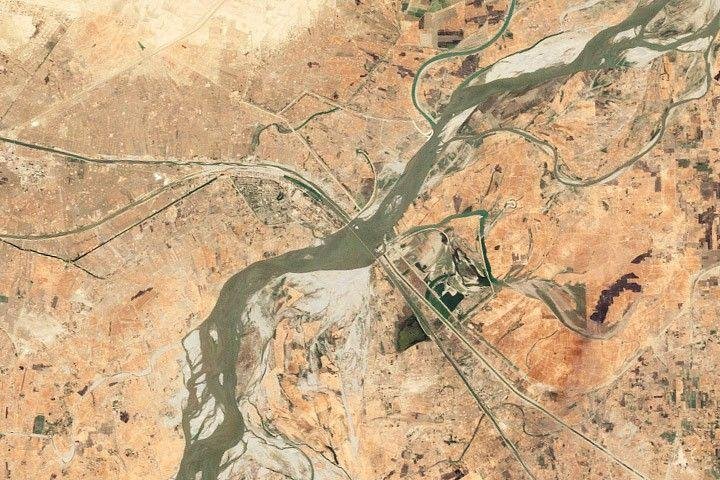
An irrigation Canal in Pakistan's agricultural heartland in the Indus Basin | NASA

Pakistan receives over 80 per cent of the Indus system's total flow, approximately 135 million acre-feet (MAF) annually, compared to India’s allocation of 33 MAF. Given this substantial water endowment, Pakistan cannot be classified as water-poor by any hydrological standard. The country’s agricultural crisis arises not from upstream deprivation, but from governance failures and insufficient measures to conserve and manage the considerable water resources already available.
Introduction
When Pakistan’s Foreign Minister Ishaq Dar warns that suspending the Indus Waters Treaty threatens “water security,” “food security,” and ultimately “national security” for 250 million Pakistanis, this rhetoric is intended to convey statesmanship. However, this narrative reflects a persistent pattern in Islamabad's political discourse: invoking the river to deflect attention from ongoing governance failures, while prioritising the obstruction of India's development over domestic advancement.
The central question for Pakistan’s citizens is why a nation that began with comparable opportunities to India in 1947 has, by 2026, adopted terrorism as an instrument of state policy rather than prioritising development as a national objective. This divergence—one path toward institutional growth and the other toward a security apparatus focused on cross-border militancy—constitutes the precedent that merits international scrutiny, rather than the constructed narrative of treaty sanctity promoted by Dar.
1. The Rhetoric Of Scarcity Versus The Reality Of Endowment
Islamabad’s diplomatic stance is based on the assertion that Pakistan is an existential victim of its upstream geography. However, the hydrological allocations established by the 1960 Indus Waters Treaty contradict this claim.
Pakistan receives over 80 per cent of the Indus system's total flow, approximately 135 million acre-feet (MAF) annually, compared to India’s allocation of 33 MAF. Given this substantial water endowment, Pakistan cannot be classified as water-poor by any hydrological standard. The country’s agricultural crisis arises not from upstream deprivation, but from governance failures and insufficient measures to conserve and manage the considerable water resources already available.
2. The Anatomy of Waste
The Indus Basin Irrigation System (IBIS) in Pakistan is the world’s largest contiguous canal network, serving over 16 to 19 million hectares (Mha). More than 85 per cent of Pakistan's cropland continues to rely on traditional, unlevelled basin and wild flood irrigation methods, which are highly inefficient. In regions such as Sindh and southern Punjab, deep percolation from canals and flood irrigation results in water loss to brackish, high-salinity aquifers, making it unavailable for agriculture and contributing to waterlogging and secondary soil salinisation on productive land.
The system receives an average annual inflow of approximately 145 MAF, with 101 MAF allocated to agriculture, 14 MAF to municipal and industrial use, and 30 MAF flowing unutilized into the sea. Only 65 MAF of the water diverted for agriculture reaches the fields, with 36 MAF lost due to system inefficiencies. The total water wasted, including unutilized flows to the sea, amounts to 66 MAF, which is twice India’s share under the Indus Waters Treaty. Therefore, Pakistan is generating its own water scarcity despite possessing one of the world's largest river endowments.
3. The Micro-Irrigation Divide: A Study In Institutional Choice
India has prioritised agricultural water productivity as a central component of national economic planning, whereas Pakistan has restricted modern irrigation initiatives to sporadic, externally funded pilot projects that have not achieved systemic scale. The institutional context in each country explains this divergence.
India institutionalised micro-irrigation as a national priority under the Pradhan Mantri Krishi Sinchayee Yojana (PMKSY) and its Per Drop More Crop (PDMC) component. A dedicated Micro Irrigation Fund routed through NABARD enables state governments to mobilise concessional loans to meet subsidy shares and finance regional projects. In contrast, Pakistan’s equivalent efforts remain largely provincial and dependent on external donors, as seen in schemes such as the World Bank-funded Punjab Irrigated-Agriculture Productivity Improvement Project. These initiatives frequently lose momentum when donor cycles end, or provincial priorities shift.
Additionally, India has developed a domestic manufacturing sector for drip tubes, emitters, filters, and fertigation equipment that adheres to BIS standards. In contrast, Pakistan relies on imported components, resulting in higher installation costs and more complex maintenance. The disparity is further intensified by differences in delivery infrastructure. India's extensive tubewell irrigation provides smallholders with on-demand, pressurised water that integrates efficiently with drip and sprinkler systems. In contrast, Pakistan’s canal-based Warabandi rotation delivers water intermittently and with high silt content, requiring farmers to construct storage ponds and settling tanks at significant expense. Indian farmers rarely face this capital barrier.
This disparity has produced a significant scale gap. India’s sustained central funding has enabled micro-irrigation to expand to over 11.5 million hectares nationwide. Within the Indus basin, the Indira Gandhi Nahar Project and Haryana’s pressurised networks conserve an additional 4.5 to 5 MAF annually. In contrast, Pakistan’s High-Efficiency Irrigation Systems have stagnated at under 250,000 hectares nationwide, saving less than 0.8 MAF per year, which is only a fraction of the losses incurred from unlined canal seepage in a single month. Indian farmers are able to utilise saved water for additional cropping cycles.
The fundamental asymmetry is clear. India developed the necessary institutions, financing mechanisms, and manufacturing capacity to scale water-saving technologies nationally, whereas Pakistan did not.
4. The Storage Vulnerability
Reservoir storage most clearly illustrates the divergence in water management between the two countries. International engineering benchmarks recommend that river basins maintain 120 to 900 days of carryover capacity to buffer against multi-year droughts, seasonal anomalies, and climate variability, as observed in basins such as the Colorado and the Murray–Darling.
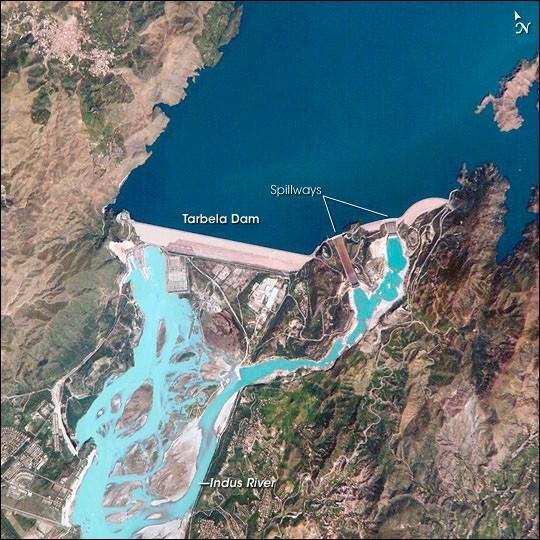
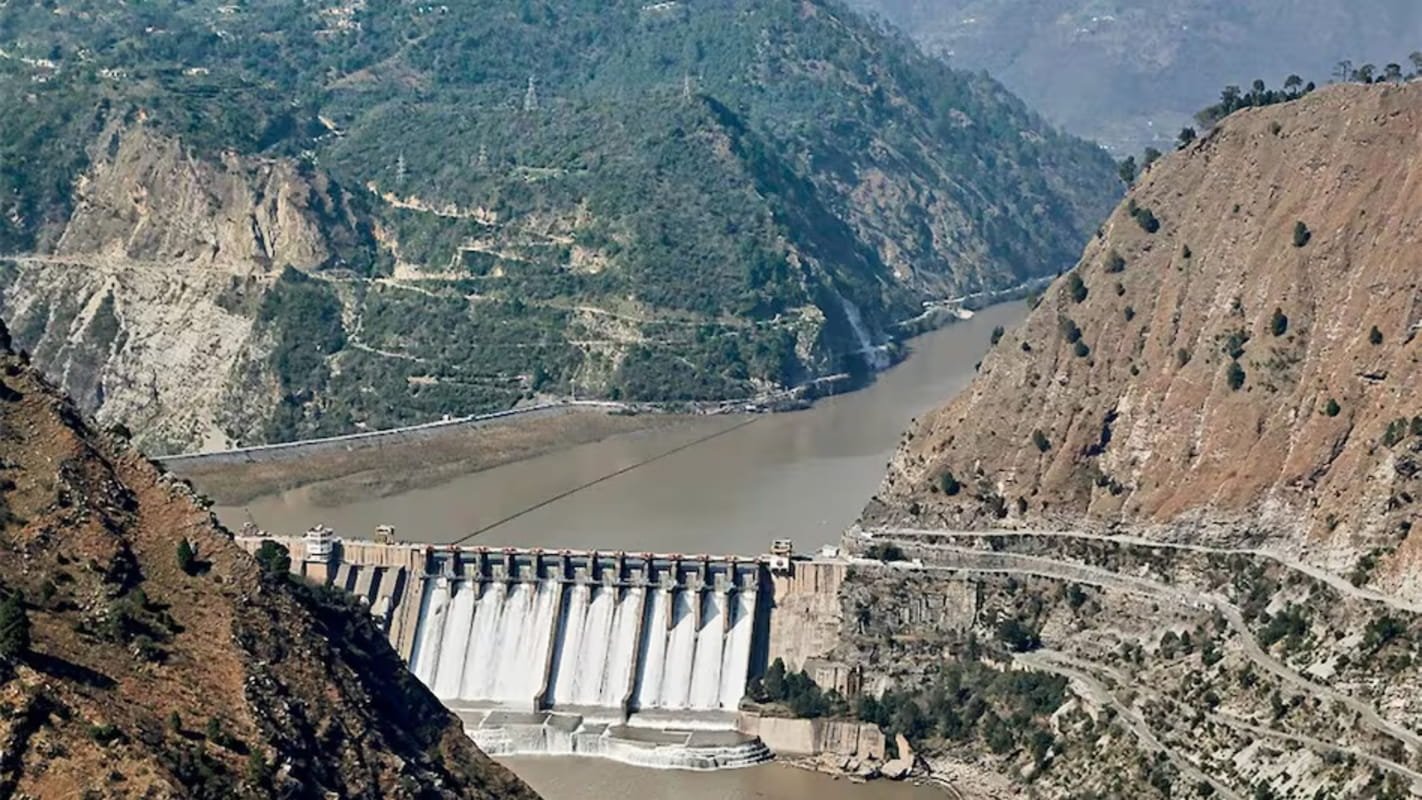
Tarbela Dam, Pakistan | NASA Science
Pakistan, which relies entirely on a single river system, has developed a usable live storage capacity of about 11.5 to 13.0 million acre-feet (MAF), representing less than 10 per cent of its total water allocation. This capacity continues to decline due to sedimentation in the Tarbela and Mangla reservoirs, limiting Pakistan’s storage buffer to approximately 30 days. In contrast, India, with a significantly smaller allocation on the Eastern rivers, has established 11.8 to 12.2 MAF of live storage across the Bhakra, Pong, and Ranjit Sagar reservoirs. This infrastructure enables near-complete seasonal regulation through the Bhakra-Beas Management Board and accounts for 35 to 37 per cent of India's water allocation, providing 120 to 150 days of carryover capacity. This is four to five times greater than Pakistan’s buffer, despite India’s smaller entitlement.
The treaty does not impose this limitation; instead, it highlights a policy failure. Pakistan's inability to construct major downstream storage facilities arises from domestic challenges.
For instance, the technically feasible Kalabagh Dam has stalled for decades because of unresolved disputes between Punjab and Sindh. Although a plan from the 1970s envisioned constructing one major dam per decade, none have been completed in the subsequent fifty years. As a result, Pakistan discharges 20–30 million acre-feet (MAF) of fresh water into the Arabian Sea during peak monsoon flows, which contributes to acute water shortages during the Rabi winter planting season.
5. External Deflection As A Substitute For Internal Governance
During periods of agricultural water stress, Pakistan’s political and security establishment frequently attributes the issue to alleged Indian “hydro-hegemony,” asserting that upstream run-of-the-river plants such as Kishenganga, Baglihar, and Ratle pose an existential threat to the nation. However, engineering assessments do not substantiate this claim.
Run-of-the-river plants do not divert or consume water; they use the kinetic energy of flowing water to generate electricity and return the entire flow to the river channel without net volumetric loss. India has developed only a fraction of the storage it is legally permitted to construct on the Western Rivers under the Treaty, which is currently suspended.
The water scarcity experienced by Pakistani farmers primarily results from the rigid Warabandi allocation system, which concentrates water access among politically influential landholders at the head of canal reaches and leaves smallholders at the tail chronically deprived. This constitutes a domestic distributive issue unrelated to India.
This pattern of externalising domestically generated challenges extends beyond water management and has shaped Pakistan's national trajectory since 1947.
Rather than investing in institutions, infrastructure, and an economic base aligned with its water resources and colonial legacy, successive governments in Islamabad have prioritised the security sector, utilising cross-border militancy as a policy instrument. This strategy shifts focus away from the need for domestic accountability amid governance failures. Assigning blame for engineered scarcity in the Indus basin and regional instability to India serves a comparable political function, allowing Pakistan's leadership to evade responsibility for decisions within its own jurisdiction.
6. Conclusion: The Strategic Balance Sheet
Foreign Minister Dar’s invocation of the treaty’s sanctity and warnings of regional consequences reflect a political strategy to externalise the effects of domestic mismanagement. The principal barrier to Pakistan’s water and food security has not been upstream engineering in Jammu and Kashmir. Instead, it is a governance approach that has consistently prioritised cross-border militancy and geopolitical grievances over infrastructure development, institution-building, and responsible resource management.
Both India and Pakistan began in 1947 with comparable starting conditions. After eight decades, one nation has prioritised development, while the other has focused on deflection. This fundamental policy divergence, rather than the river itself, requires explanation to Pakistan’s citizens.
References & Data Sources
[The article is exclusive to NatStrat. The views expressed by the author(s) are personal and do not necessarily reflect the views of the organisation.]
Separating Reality from the Rhetoric: Facts, Fiction, and the Indus Waters Treaty