

@NatStrat

The WTO Trade Policy Review helps collate general impressions about a country’s trade and economic regulatory environment. Coming after five years, India’s TPR 2026 remains largely optimistic and constructive, taking stock of significant progress in the intervening period while noting areas for improvement.
Introduction
The World Trade Organisation (WTO) recently concluded its Eighth Trade Policy Review (TPR) for India, outlining developments in India’s macroeconomic, industry and trade policies during the period 2021 to 2025. The WTO’s TPR process in general is neither overtly critical nor prescriptive; however, it gives the country under review an opportunity to highlight its policy and economic successes to the global community and respond to concerns. It is also a platform for WTO members to understand an economy’s policy changes, raise issues and suggest actions.
Trade Policy Review 2021
India’s last TPR was undertaken in 2021, and the most recent review helps to assess the economy’s post-pandemic recovery. Notably, this period also witnessed structural shifts in the geopolitical and global trade environment, marked by military conflicts, energy shocks, supply chain disruptions and shifts, and aggressive use of trade-related measures to meet strategic objectives. Navigating these challenges while ensuring economic and trade resilience posed a particular complexity for India, a large economy on an accelerated growth trajectory.
The previous WTO report summary for India, as of January 2021, notes that while key reforms such as the Goods and Services Tax and the Insolvency and Bankruptcy Code were introduced after 2015, trade policies remained ‘broadly unchanged’ and FDI liberalisation continued. Initiatives towards trade facilitation, such as automation of the customs system, reduction in the number of documents, and introduction of ICEGATE, SWIFT, the Authorised Economic Operator programme, and others, were appreciated.
At the same time, the TPR 2021 observed that numerous circulars and notifications were issued on tariffs, export taxes, minimum import prices, trade restrictions, and licensing, adding to uncertainties in India’s overall trade environment between 2015 and 2020. Further, the simple average applied MFN tariff trended upwards from 13 per cent in 2014-15 to 14.3 per cent in 2020-21. The Chairperson's concluding remarks summarised WTO members' interventions, with chief concerns including tariff complexity and uncertainty and rising tariff rates, among others.
Trade Policy Review 2026: WTO Secretariat report
The 2026 review appears to be qualitatively more positive. The process includes a report by the WTO Secretariat and one from the Government of India, with close to 1100 written questions from 44 members and the participation of 68 delegations at a two-day meeting. The Chairperson’s concluding remarks highlight some of the points raised by members.
The WTO report summary describes India’s policy changes but largely stays away from offering judgmental comments. It notes that India must sustain an annual average growth rate of 8 per cent to achieve its long-term vision of Viksit Bharat, and posted 7.3 per cent between 2022-23 and 2025-26. Its trade profile reflects a shift from traditional, low-value-added goods to more technology-intensive products, but its participation in global value chains has yet to reach the ASEAN average. The report lauded India’s robust digital economy, led by expanding digital public infrastructure, and impressive growth of 17.3 per cent in digitally delivered services between 2021 and 2025.
To meet its export target of a 10 per cent share of global merchandise exports by 2047, India introduced a new foreign trade policy with no end date, including remission of taxes and duties on exports and ease of doing business. The report also noted the expanding range of regional trade agreements the country has entered into. This contrasts with the 2021 TPR, which noted that India did not conclude any trade agreement in 2015-2021 and urged it to finalise negotiations.
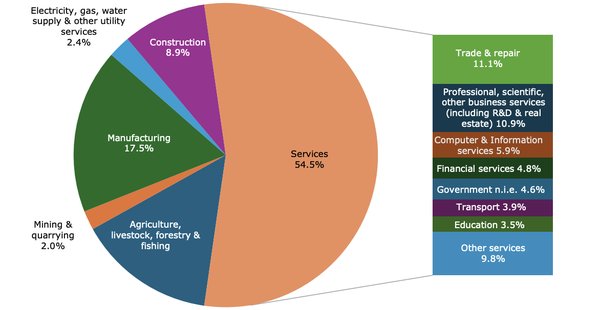
WTO Secretariat Calculation of India’s Economic Structure: Sector Share in Gross Value Addition 2023-24| WTO Trade Policy Review: India
The 2026 review touched on the institution of a new National Trade Facilitation Action Plan 3.0 and the continuing efforts to improve cross-border goods movement. Average import release times dropped by about 6 hours at seaports and the WTO Trade Cost Index declined between 2020 and 2022. While this is a significant achievement, India’s Trade Cost Index for goods stood at 3.3 in 2022, similar to the EU, as compared to 2.8 for China, Malaysia, Thailand and Vietnam (2.9).
India has reduced the number of tariff rate slabs to 8 for industrial goods, alleviating complexity. However, the average applied MFN rate remains elevated at 15.7 per cent, including various added rates. Other instruments such as minimum import prices, import and export restrictions and licensing, state trading, export taxes and minimum export prices continue to be deployed.
To promote manufacturing and exports, India has moved from tax incentives to grant-based support, including at the state level. The Standards National Action Plan 2022-27 has been launched, and the number of accredited laboratories for testing and certification surged from 2500 to 9772 between 2015 and September 2025, a positive development that will support export goods meet domestic and international standards.
Sectorally, the TPR seems to approve of most of the policies instituted, while suggesting that agricultural trade regulations are directed towards strengthening food security and stabilising markets. In the manufacturing sector, it alludes to multiple constraints such as gaps in industrial infrastructure, high capital costs, and operational hurdles, among others. Better financial regulations and digitalisation helped the banking sector, and the insurance sector benefited from increased FDI limits. The multimodal transport strategy was appreciated for its contribution to merchandise trade and tourism.
The conclusion set out in the TPR commends India’s deft balancing of outward orientation with self-reliance and growth. It does point out that addressing structural barriers such as trade costs, regulatory complexity, infrastructure gaps, and hurdles to global integration will be critical to its future growth and resilience as it moves towards the target of Viksit Bharat.
Chairperson’s Concluding Remarks
The concluding remarks by the Chairperson, however, clearly highlight the issues faced by WTO members in trading with India, chief among them being the lack of predictability and transparency in trade policies. The situation for trading partners does not seem to have improved between the Seventh and Eighth TPRs, with many of the same concerns being raised.
First, members stated that sudden changes in tariffs and export restrictions take place without prior consultation with partner countries or businesses, increasing regulatory complexity in India. Approvals and processes are delayed without explanation.
Two, India’s regime of standards, technical regulations, and Quality Control Orders (QCOs) was a key concern for trade partners, who pointed to delays in conducting factory visits, lack of timelines, and the absence of consultation procedures in granting approvals. According to WTO members, India needs to simplify conformity assessment requirements, better align with international standards and recognise more foreign laboratories and certifications,
Three, clarifications were sought on India’s digital regulatory framework, highlighting issues such as data governance, cross-border data flows, IPR in AI, data localisation and the Digital Personal Data Protection Act. Members called for more transparent, predictable and innovation-friendly regulatory structures to facilitate digital trade and investment.
Four, India’s Production Linked Incentive scheme was questioned on its alignment with WTO subsidy requirements, with members raising issues such as high tariffs, import substitution and public procurement measures for strategic sectors.
Five, on trade facilitation, implementation of risk management systems, expansion of the authorised economic operator program and improvement of the ‘faceless’ customs system were taken up.
Many of these gaps appear entrenched in India’s cross-border and production systems, despite ongoing efforts to close the distance. In particular, elevated import duties are often cited as detracting from India’s competitiveness. Some QCOs were rolled back over the last year, but the majority continue to pose challenges for importers. Although the TPR process is non-binding and does not prescribe policies, India needs to address these issues at a faster pace to meet its own growth ambitions.
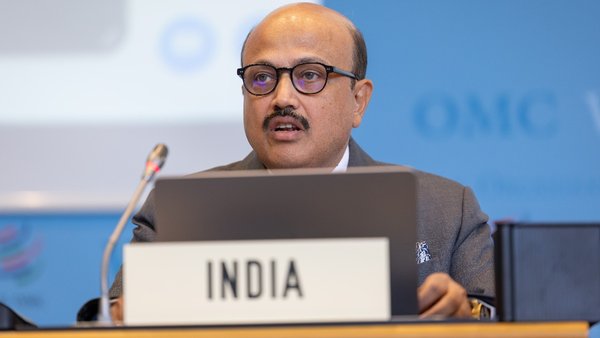
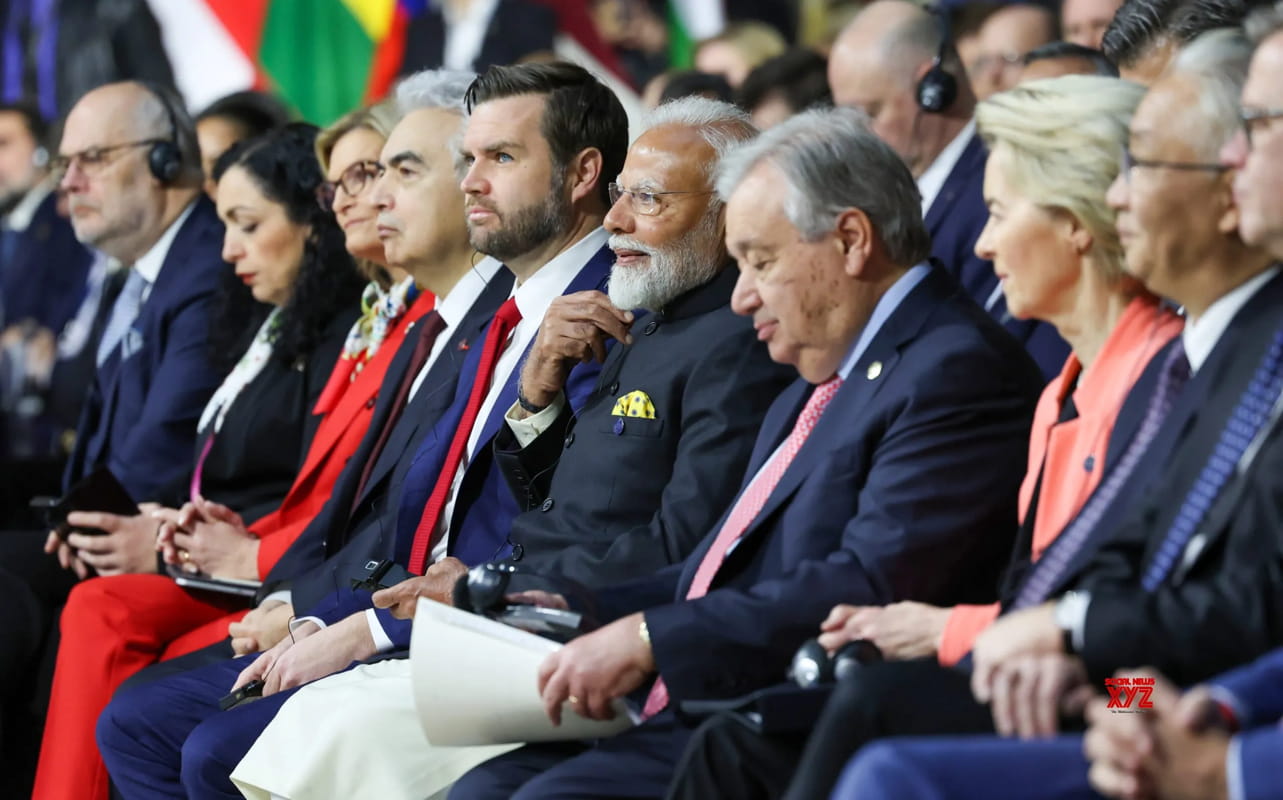
Commerce Secretary Rajesh Agarwal at 8th WTO TPR for India | WTO
India’s Submission
The Indian government’s submission captures key economic and trade trends, reform policies and developmental programs, foreign trade policy and trade facilitation, and the country’s engagement with the WTO as well as its trade agreements and interactions on multilateral forums, including hosting the G20 Summit. Total exports increased from USD 676.5 billion in 2021-22 to USD 825.3 billion in 2024-25, while imports rose from USD 760.1 billion to USD 919.9 billion.
The government report to the WTO concludes by emphasising continued investments in infrastructure, sectoral capacities, credit flows, and social and skill development initiatives, all contributing to resilient growth.
Conclusion
India is well-positioned to leverage ongoing global trade shifts, enjoying multi-sectoral capacities at both ends of the manufacturing scale, a vibrant services economy, and a massive youth dividend. Its progress in areas such as trade process digitalisation and trade facilitation over the last few years stands out, yet continuing anomalies distort the business environment that hinder it from fully converting its advantages for addressing external markets. Policy unpredictability, an increasing rather than declining discretionary role for officials, and arbitrary actions act against trade clarity. A strategic approach to manufacturing, FDI, and exports that addresses the ecosystem as a whole would better serve India’s external engagement.
The WTO Trade Policy Review helps collate general impressions about a country’s trade and economic regulatory environment. Coming after five years, India’s TPR 2026 remains largely optimistic and constructive, taking stock of significant progress in the intervening period while noting areas for improvement.
It may be noted that the review is undertaken from the perspective of countries wishing to expand their exports to India, while India aims at greater self-reliance and higher exports to the world, an inherent contradiction in the WTO forum. Some of the issues raised by members would reflect their primary interests, and their concerns may not be justified on the ground, as seen in India’s growing exports and imports.
At the same time, having set targets of USD 1 trillion in exports of goods and services each by 2030 and aiming to reach 10 per cent of global exports by 2047 from the current 1.8 per cent, India has a long way to go in terms of lowering trade costs, infrastructure build-out, credit availability, and production and trade at scale. The TPR, while not expected to directly provoke change in India’s trade policies, is nevertheless a timely reminder that the country must work strenuously to improve ease of doing business across all sectors.
[The article is exclusive to NatStrat. The views expressed by the author(s) are personal and do not necessarily reflect the views of the organisation.]
Building India's National Cyber Reserve Force: Feasibility, Models, and Strategic Value
How Neighbouring Countries' Debt Crises Are Reshaping India's Foreign Policy
From Summits to Structures: Rethinking the India-Africa Partnership

Cyber Deterrence in the Indian Context: Constraints, Credibility and Escalation Risks
A National Economic Security Doctrine: Defining India’s External Engagement