

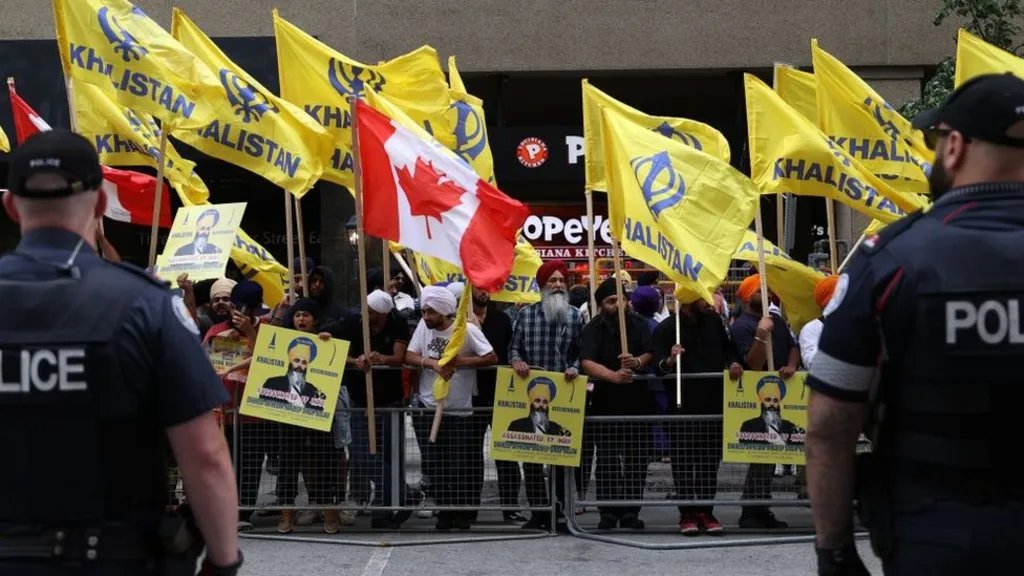
Pro-Khalistan Supporters protesting in Front of the Indian Consulate in Toronto | Getty Images

Initiatives such as the Baku Initiative Group should be viewed with due seriousness by India’s security and intelligence agencies, particularly where there are concerns about coordinated anti-India narratives or external influence. They suggest that Azerbaijan is willing to become the new epicentre for the so-called “Khalistan” movement driven by its diplomatic tilt towards the Pakistan-Türkiye-Azerbaijan axis.
Introduction
India’s Ministry of External Affairs has a detailed account on its website of the civilisational links between India and Azerbaijan that go back in history and predate the modern era. These spanned not only cultural links but also trading routes. During Soviet rule, India enjoyed good relations with Heydar Aliyev, the long-standing leader of the Politburo of the Communist Party of the Soviet Union from Azerbaijan. Following the dissolution of the Soviet Union, Azerbaijan has steadily drifted towards Pakistan, based on perceived empathy and affinity, despite the many complementarities and opportunities that exist between India and Azerbaijan, including in recent years in the areas of energy and tourism. Azerbaijan has in fact become one of the favourite destinations for Indian tourists.
Today, the political relationship is marred by friction and suspicion. Azerbaijan has chosen to become a member of the OIC Contact Group on Jammu and Kashmir along with the ‘brotherly triad’ of Pakistan and Türkiye. It has gone beyond to become a consistent backer of Islamabad in the international arena, as evidenced on the so-called “Kashmir issue” and during the 2025 Operation Sindoor, India’s response to the major terrorist attack in Pahalgam that emanated from Pakistan in April 2025.
Most recently, in a new and worrying development, Azerbaijan has offered its good offices to play host to the so-called “Khalistan” movement – a role historically associated with Western democracies such as Canada, the United Kingdom, the United States and Australia, who have now become less willing owing to deepening strategic and economic ties with India.
BIG: The Baku Initiative Group
On 16 January this year, an Azerbaijani think-tank called the Baku Initiative Group (BIG) organised an international conference titled “Racism and Violence Against Sikhs and Other Minorities in India: The Reality on the Ground” that discussed India’s alleged repression of its ethnic minorities and observed a minute-long silence at the opening of the ceremony to honour the life of Hardeep Singh Nijjar, a designated terrorist in India who was killed in Canada in 2023.
BIG was established in 2023 during an anti-colonialism Conference hosted by the 19th Non-Aligned Movement Summit in Baku. It acts as a platform for organising events, reports, lobbying efforts and international outreach. Its website describes it as an organisation dedicated to supporting global struggles against colonialism and neo-colonialism, and in favour of independence and the protection of the rights of indigenous peoples and ethnic minorities. The Organisation’s initial focus was on France, a traditional backer of its arch-rival Armenia. In 2024, it organised a Conference on European colonialism at the United Nations Headquarters in New York that was attended by representatives from French overseas territories such as French Guyana, Martinique and New Caledonia. Notably, the conference took place a month after Paris had accused Baku of supporting rioters against the French Administration in New Caledonia.
BIG is headed by Abbas Abbasov as its Executive Director, who has previously worked for the State Oil Fund of the Republic of Azerbaijan (SOFAZ) as a foreign affairs and protocol service specialist, raising questions about the partisan nature of the organisation. This is one of the few details about the organisation that are in the public domain. Notably, its funding sources are largely opaque.
The Conference on 16 January 2026 that focused on claims of oppression of Sikhs in India is the first time the BIG has turned its attention to India. This, coupled with Baku’s growing alignment with Islamabad and Ankara, often referred to as the ‘Three Brothers’, will mean that India-Azerbaijan relations will further slide downwards, compounding Baku’s existing anti-India stance on Kashmir, use of the term “IOJK” by its state media, mirroring Pakistan’s description of Jammu and Kashmir, and explicit support to Pakistan at the UN, OIC and during Operation Sindoor. The BIG Conference has provided a ready-made platform for anti-India separatist groups to peddle their narrative and poison Baku’s ties with India.
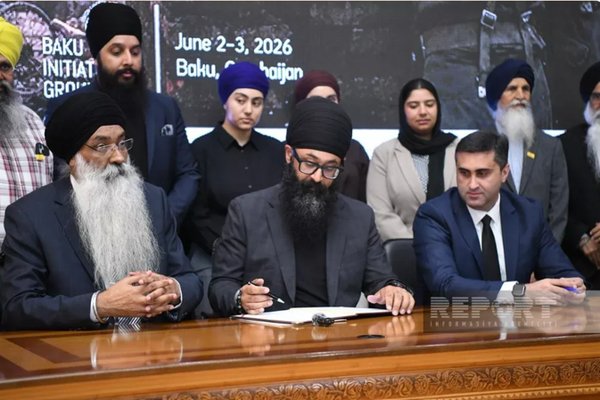
Dabinderjit Singh Sidhu (Left), Moninder Singh (Centre) and Abbas Abbasov (Right) | Caliber (Azerbaijan)
Timeline of Events
“BIG” is Suspect
The hosting of anti-India seminars, conferences, and events to commemorate separatist “Khalistani” leaders and promotion of narratives that align with Pakistan’s strategic interests comes at the cost of credibility for BIG. While the group claims to stand for anti-colonial initiatives and human rights, it is partisan and political in nature. This raises doubts about its objectivity and motives. To compound the problem, the lack of information about its funding and leadership structure, with few details available on its website, raises further eyebrows about its credentials.
Initiatives such as the Baku Initiative Group should be viewed with due seriousness by India’s security and intelligence agencies, particularly where there are concerns about coordinated anti-India narratives or external influence. They suggest that Azerbaijan is willing to become the new epicentre for the so-called “Khalistan” movement driven by its diplomatic tilt towards the Pakistan-Türkiye-Azerbaijan axis.
The timing and methodology of BIG lack both justification and common sense. BIG’s foray into the so-called “Khalistan” issue is nothing more than tilting at windmills. This “issue” exists only in the imagination of its external proponents. Why is it difficult for them to understand the simple fact that over 22 million Indians professing the Sikh religion live peacefully across the length and breadth of the country, making invaluable contributions in all facets of public life?
The Baku Initiative Group is destined to fail in its attempts to manufacture divisions where none exist. Azerbaijan would be better advised to expend its energies and political capital building relations with India as the rest of the world is doing, looking to the future rather than the past.
References